


A personalized closet is a storage setup shaped around your actual life, not the imaginary person your builder had in mind. If your personalized closet research started because your bedroom chair has become a second dresser and every morning feels like a small scavenger hunt, here’s the good news: the problem usually is not you, and it is not just “too much stuff.”
What a Personalized Closet Actually Is
A personalized closet is a closet designed around your space, your wardrobe, your habits, and your style preferences. That sounds simple, but it changes everything. Instead of one high shelf and one lonely rod stretched across the wall, you get storage planned for the kinds of clothes and accessories you actually own.
In plain English, a personalized closet means your long dresses are not crushed under a too-low rod, your sweaters are not teetering in unstable piles, and your shoes are not breeding on the floor like rabbits. It is less about making a closet look fancy and more about making it finally work.
The standard closet setup in many homes is bare-minimum storage. A single hanging rod and shelf might be enough in a listing photo. It is rarely enough once real mornings, real laundry, real shoes, and real seasons move in. Personalized design fixes that by turning a blank cavity into a system.
Personalized vs. custom vs. modular: what each term means
These words get tossed around together, and that creates confusion.
“Personalized” is the big idea. It means the closet fits your needs instead of forcing your needs to fit the closet. That can happen through different methods.
“Custom” usually means built specifically for your closet’s dimensions and layout. If your walls are out of square, your ceiling slopes, or your storage needs are very specific, custom design works around those details instead of pretending they do not exist. A closet system built around real measurements usually falls into this category.
“Modular” means the closet is made from adjustable components, like shelves, drawers, and rods that can be configured in different ways. Modular does not have to mean generic. A well-planned modular setup can still feel highly personal because the parts are chosen and arranged around your life.
Semi-custom sits in the middle. You get more flexibility than a basic kit, but not the full one-off build of fully custom millwork.
The core idea: your closet should match how you live
Here’s the thing: the point is not luxury for luxury’s sake. The point is friction.
If you wear work clothes Monday through Friday, your everyday section should be the easiest to reach. If your closet has to handle boots in winter, sandals in summer, gym clothes, handbags, and two weeks of folded laundry that never quite makes it to drawers, the layout should reflect that.
A personalized closet works because it respects the small repeated moments that shape your day. The 7:15 a.m. rush. The late-night toss of a cardigan onto a chair. The Saturday clean-up that falls apart again by Tuesday. Fix the layout, and those moments get easier.
Why Standard Closets Stop Working
Most closet frustration builds slowly. First it is one extra bin. Then a hanging organizer. Then a shelf insert. Then a pile on the floor that becomes normal because you are tired of fighting it.
That breaking point is common for a reason. Standard closets are designed to be acceptable, not effective. They offer just enough structure to count as storage, but not enough intelligence to support daily use.
Most closets are built for resale, not real routines
A builder-grade closet is meant to offend nobody and impress nobody. It is the storage version of plain beige paint. Safe. Generic. Easy to copy across dozens of homes.
The problem is that generic layouts waste space in predictable ways. The top shelf sits too high to use well. The hanging rod takes up the full width even if half your wardrobe would fit better folded. The vertical space above hanging clothes goes empty. Shelf spacing makes no sense. Nothing is planned around shoes, bags, small accessories, or laundry.
That kind of closet looks fine until you actually live with it.
The problem is rarely “too much stuff”
This is worth saying clearly: bad layout causes more chaos than quantity alone.
Of course, some closets are overstuffed. But many are simply mismatched to what they are holding. Ten folded sweaters on one deep shelf become an avalanche. Five pairs of everyday shoes pile up at the base because there is nowhere logical for them to go. Belts, watches, and scarves disappear because they are stored as if they are random clutter instead of categories.
When storage does not match item type and frequency of use, clutter spills outward. You can declutter every season and still feel buried.
If that sounds familiar, it helps to compare temporary organizers with a real built-in layout. The difference is not just tidiness. It is structure.
Why organizers and shelf inserts only go so far
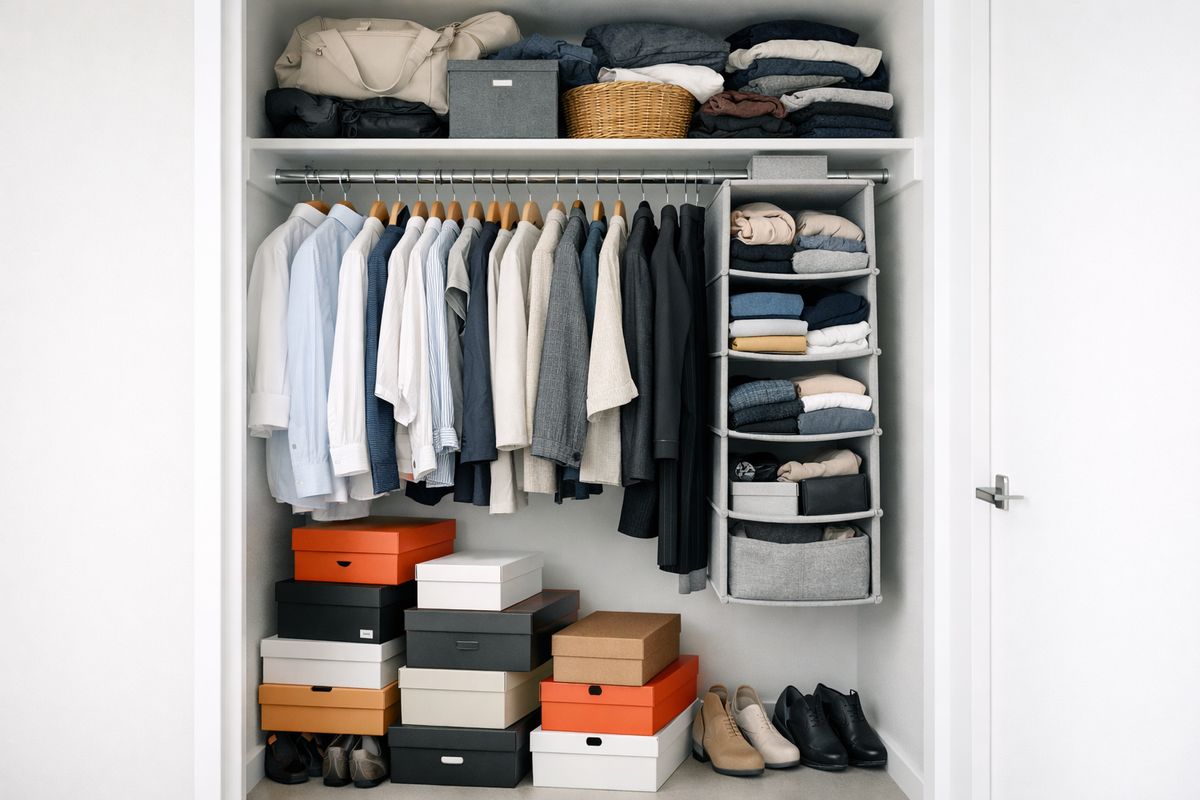
You have probably already tried the usual fixes. Bins. Hanging shelves. Shoe racks. Drawer dividers. Extra hooks. Maybe a clear box system that looked promising online and annoyed you by the next weekend.
Those add-ons can help, but only up to a point. The catch is that most of them work around the original problem instead of solving it. If the rod is in the wrong place, a hanging organizer just competes with your clothes. If the shelf is too high, another bin only makes the problem harder to reach. If the closet has no proper home for shoes, stacking gadgets just creates a mess with edges.
Add-ons are not useless. But they are often like putting more containers into a kitchen with badly placed cabinets. You can label everything beautifully and still hate making dinner.
The Parts That Make a Closet Personalized
A better closet is not one magical product. It is a set of choices. Once you break it down that way, the whole idea feels much more practical.
Every personalized closet combines a few core building blocks. The right mix depends on what you own and how you use it.
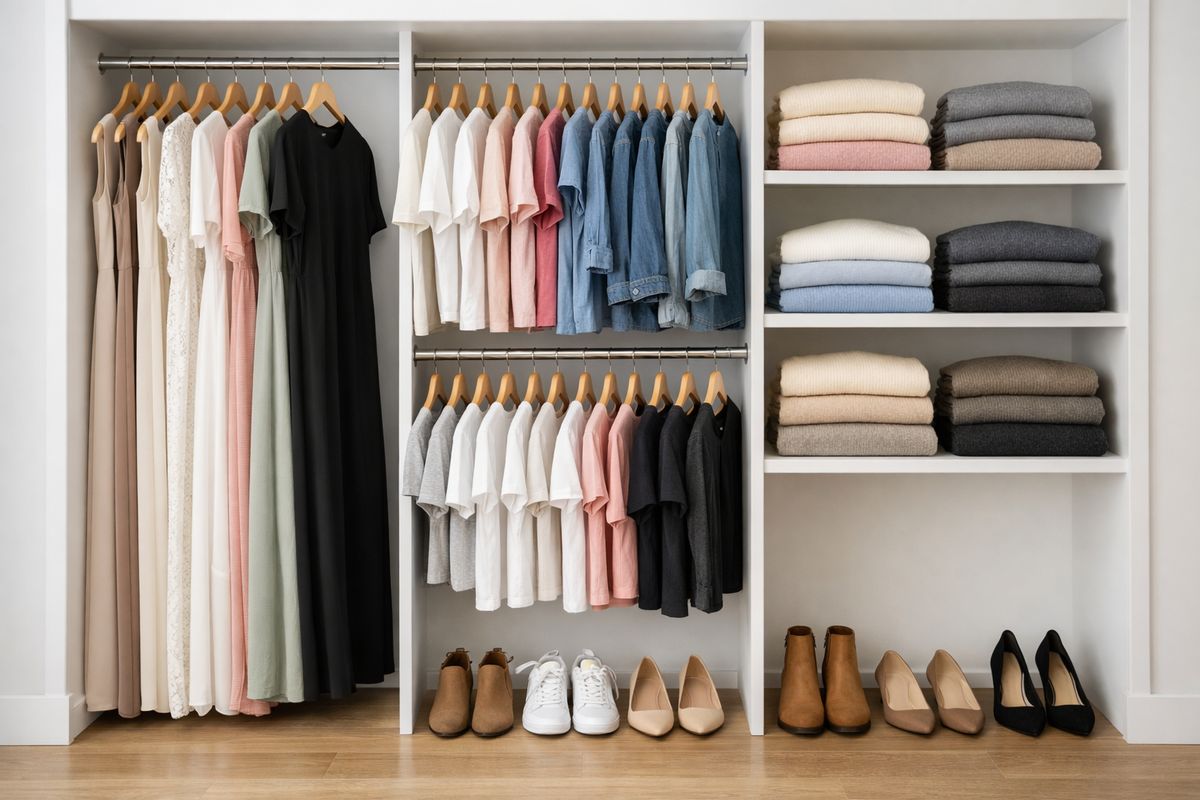
Hanging zones for short, long, and double-hang clothing
Rod placement has a huge effect on how much a closet can hold. It also affects whether you can actually see and reach what is there.
Long-hang space is for dresses, coats, robes, jumpsuits, and anything else that needs full height. Short-hang space is for shirts, jackets, folded pants on hangers, and skirts. If most of your hanging clothes fall into that second group, a double-hang layout can nearly double usable hanging capacity by stacking one rod above another.
That is one of the simplest examples of personalization. A standard closet treats all hanging clothes the same. A smart closet separates them by length.
Shelves, drawers, and baskets
Shelves are best for folded items, bags, hats, and storage bins that are meant to stay visible and easy to grab. The trick is spacing. Too tall, and you waste space. Too short, and stacks get crammed. Too deep, and the back half turns into a lost-and-found bin.
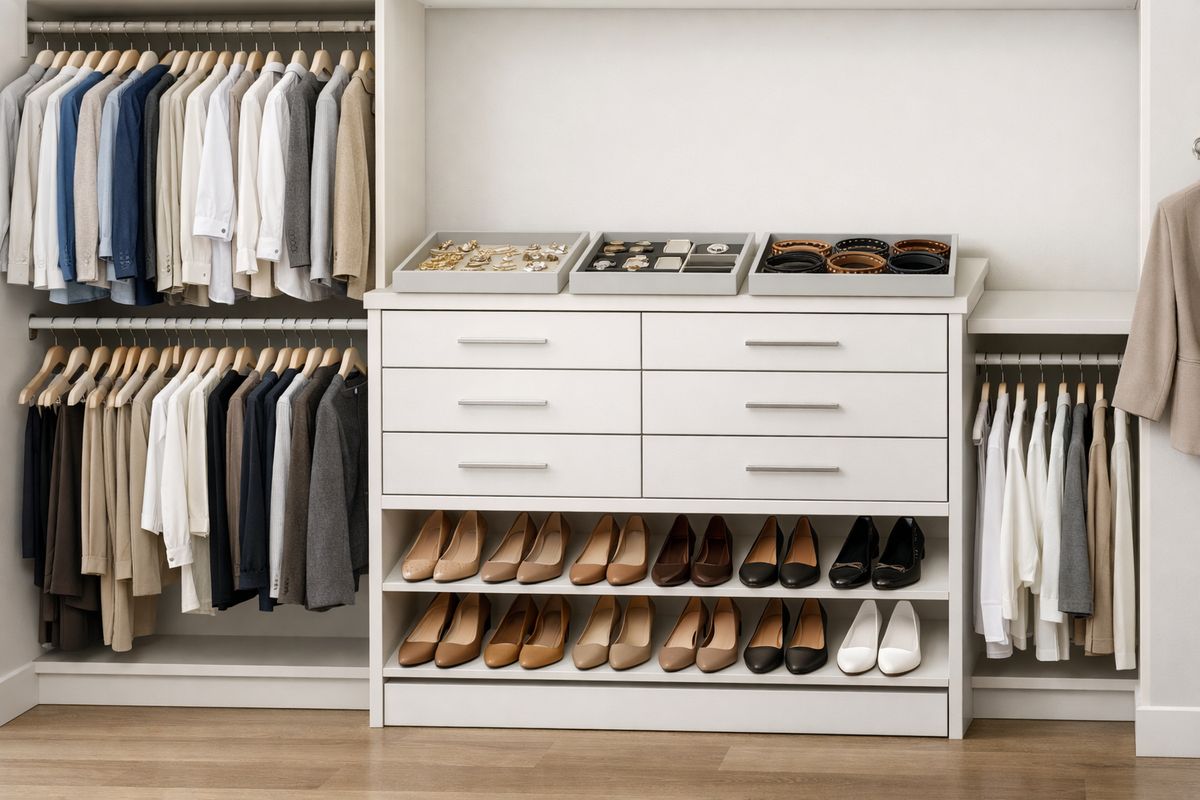
Drawers are useful for smaller items and visual calm. Socks, underwear, sleepwear, workout gear, t-shirts, and accessories stay contained without making the whole closet look busy. If open shelving is honest, drawers are forgiving.
Baskets are the flexible middle ground. They work well for items that do not need a polished drawer but still need a home, like scarves, seasonal accessories, beach cover-ups, or grab-and-go gym clothes.
Shoe storage that fits what you actually wear
Shoe storage is where a lot of closets quietly fail. One narrow rack does not solve much if your real life includes sneakers for weekdays, boots in winter, sandals in summer, dress shoes for events, and the pair you keep meaning to return.
Some closets need flat shelves. Some benefit from angled racks that make shoes easier to see. Some work best with cubbies. Some need floor-level boot storage with extra height. The right solution depends less on what looks pretty in a catalog and more on whether your daily reality is flats, heels, boots, size 12 sneakers, or a mix of all of it.
Specialty storage for the awkward stuff
The awkward stuff is usually what makes a closet feel unfinished.
Jewelry needs shallow storage so pieces do not tangle. Belts and ties need hooks or narrow pull-outs. Handbags do better on shelves with enough width and support. Watches, hats, laundry, and luggage need somewhere intentional to go. A pull-out hamper can keep dirty clothes off the floor. A valet rod can hold tomorrow’s outfit or a freshly steamed jacket. A mirror saves a trip across the room.
These are small details, but honestly, they often make the biggest everyday difference because they stop the little annoyances that add up.
Lighting, doors, and finish choices
Function matters first, but feel still matters.
Lighting improves visibility, especially in deep reach-ins or closets with poor overhead light. Motion-sensor LEDs are popular because they solve a real problem without adding effort. Doors also change how a closet behaves. Closed storage hides visual clutter and protects items from dust. Open sections offer quick access and can make a small space feel lighter.
Finish choices do more than change the look. They help the closet feel connected to the rest of your home. That matters because a closet should not feel like a utility corner you tolerate. It should feel like part of the room.
Why a Personalized Closet Works Better in Daily Life
A personalized closet works better because it reduces friction in the exact moments that wear you down. Not in theory. In practice.
You notice it when the sweater stack stops collapsing. When the left shoe is where it should be. When putting away laundry takes three minutes instead of becoming Sunday’s argument with yourself.
It uses the full space instead of wasting half of it
Most closets waste more space than you realize. Height gets ignored. Corners turn dead. Narrow sections get underused. Awkward walls are treated like a reason to give up.
Personalization fixes that by treating the closet as a whole volume, not just a wall with a rod. Vertical storage can handle out-of-season items or less-used accessories. Upper shelves can hold labeled bins or luggage. Narrow towers can become shoe storage or drawers. Even older homes with odd dimensions benefit when the plan respects the space instead of fighting it.
That is why storage ideas that fit the way you actually live tend to outperform anything off the shelf. The hidden win is not just more room. It is more usable room.
It makes getting dressed faster
You feel the benefit most in the morning.
If your work tops are grouped together, everyday shoes have a dedicated zone, and accessories are visible instead of buried, getting dressed becomes much more automatic. You stop opening three places to find one thing. You stop re-folding piles just to reach the sweater at the bottom. You stop mentally keeping track of where the “good black pants” ended up after laundry.
Good closet design reduces decision fatigue because it reduces visual noise. Your options are easier to see, easier to compare, and easier to put back.
It keeps clutter from leaking into the bedroom
The chair in the corner usually is not the real problem. It is a symptom.
When a closet cannot handle your actual wardrobe, overflow spreads. Clothes land on a bench, then a dresser top, then the foot of the bed. Shoes creep into corners. Accessories collect in bathroom drawers because the closet has no place for them. The whole bedroom starts carrying storage duties it was never meant to carry.
A personalized closet pulls that mess back inside the space designed to hold it. That alone can change how the whole room feels.
It is easier to maintain because everything has a real home
Organization sticks when reset is easy.
That is the part glossy photos leave out. A closet is only good if you can use it on a normal Tuesday when you are tired and not in an organizing mood. If every item has a logical, reachable home, putting things away becomes nearly automatic. Shirts go here. Gym shorts go there. Worn-once jeans have a shelf. Laundry has a hamper. It takes seconds, not effort.
The simpler the system feels, the longer it lasts.
It can feel calmer, not just cleaner
A better closet does more than cut clutter. It lowers the background stress of living around unfinished piles and hard-to-find things.
That calm is real, even if it is hard to measure. Research shows more than 57% of homeowners prefer custom-designed closet layouts for both efficiency and visual appeal. That makes sense. A closet is not just a container. It is part of your daily rhythm, and when it finally works, your home feels more settled.
The Real Reason Personalization Beats Generic Storage
“More organized” is true, but it is not the whole story. The deeper reason personalized closets work better is design logic.
A generic closet gives you empty space and leaves you to improvise. A personalized closet decides what that space is for.
A good closet is built around categories, not empty space
There is a big difference between storing “clothes” and storing categories.
Denim behaves differently from handbags. Long coats need different dimensions than folded knits. Everyday sneakers should not compete for space with formal heels you wear twice a year. When a closet is planned around categories, each type of item gets the kind of storage that actually suits it.
That is why tailored systems feel easier to use. You are not constantly making micro-decisions about where something should go. The answer is already built in.
Frequency matters: daily items belong where your hand lands
The best closet design rule is simple: daily items belong in prime real estate.
That means eye-level or easy-reach storage for the clothes, shoes, and accessories you use all the time. Special-occasion pieces, luggage, and off-season items can go higher, lower, or farther back. The principle is the same one that makes a good kitchen work. Your coffee mugs do not belong in the highest cabinet. Your daily shoes should not live on a top shelf.
When layout matches use frequency, your closet supports your routine instead of interrupting it.
Better proportions create better habits
Proportions sound technical, but the effect is very human.
If a shelf is too deep, it becomes a black hole. If drawers are too shallow, they overfill. If rods are too high, you stop using the upper section. If a hamper is inconvenient, laundry lands on the floor. Small design misfires create bad habits because the easier option wins.
Good proportions do the opposite. They make the right action easier than the messy one. That is how a closet stays organized after the initial excitement wears off.
Types of Personalized Closets
Personalization can happen in almost any format. You do not need a sprawling boutique-style dressing room for the idea to work.
In fact, smaller and trickier closets often benefit the most.
Walk-in closets
A walk-in closet gives you room to create zones. Hanging on one wall, folded storage on another, shoes in a tower, accessories in drawers, maybe even a small island or bench if space allows. Visibility improves because you can spread categories out instead of stacking everything vertically.
That said, a walk-in is only better if the layout is thoughtful. A big closet with random shelves can still waste space. The advantage of a personalized walk-in is not just size. It is zoning.
Reach-in closets
Reach-ins are where smart design really earns its keep.
Because the footprint is smaller, every inch has to work. Double-hang rods, vertical shelf towers, slim drawers, overhead shelves, and better door planning can turn a frustrating reach-in into something surprisingly efficient. You do not need more square footage to get a better result. You need a better use of the square footage you already have.
Shared closets
Shared closets fail when one layout tries to force two routines into one generic setup.
Personalization fixes that with separate zones, different rod heights, dedicated drawers, shoe sections, and clear ownership of space. If one side needs more folded storage and the other needs more hanging room, the closet should reflect that. Fairness matters here, but function matters more. Equal width is not always equal usefulness.
If you want a deeper look at dividing space without daily resentment, making a shared closet feel balanced helps clarify what fair design actually looks like.
Small or awkward closets
Older homes and unusual layouts often come with quirks: sloped ceilings, deep corners, short walls, off-center doors, low soffits, odd alcoves. These spaces can feel impossible with generic products because standard dimensions assume standard rooms.
Personalized design works better because it starts with the constraints. Instead of asking the room to act normal, it uses the odd spots intentionally. That narrow section becomes shelves. That awkward corner becomes a hamper pull-out. That sloped area handles low storage or shoes.
Personalized Closet Features Worth Considering
Not every feature in a catalog deserves a spot in your closet. Some are genuinely useful. Some are just nice to look at. The trick is knowing the difference.
Adjustable components for life changes
Adjustability is one of the smartest things to pay attention to, especially if your wardrobe shifts over time.
Maybe your workwear needs are changing. Maybe a teenager will inherit the room later. Maybe you want flexibility if you sell the home. Adjustable shelves and rods let the closet evolve without forcing a full redo. That is one reason modular and semi-custom systems keep growing in popularity. The value is not only upfront cost. It is future-proofing.
Closed storage vs. open storage
Closed storage gives you a calmer look. It hides clutter, protects items from dust, and helps a closet feel tidier even on imperfect days. Market data suggests closed closets hold 55% of demand, which is not surprising if you have ever wanted visual quiet more than display space.
Open storage offers quicker access and a lighter appearance. It also forces more discipline because everything is visible. In practice, many of the best closets mix both. Open shelves for often-used items, closed drawers or cabinets for the messier categories.
Built-in hampers, mirrors, and valet rods
These are the features that can sound minor until you use them.
A built-in hamper keeps laundry from drifting into corners. A mirror lets the closet support dressing, not just storage. A valet rod gives you a place for tomorrow’s outfit, dry cleaning, or packing. None of these features is dramatic, but all of them remove little points of friction.
And that is usually what a successful closet upgrade is really about.
Sustainable materials and low-VOC finishes
Some homeowners care a lot about material choices. Some care once the options are in front of them. Either reaction is fair.
Sustainable materials can include recycled wood content, rapidly renewable options, or lower-emission finishes. Low-VOC means the finish releases fewer volatile organic compounds, which can matter for indoor air quality and odor. Research shows more than 40% of consumers prefer recycled wood or low-VOC finishes, so this has moved well beyond a niche concern.
Smart features: when they help and when they do not
Smart features are useful only when they solve a real annoyance.
Motion-sensor lighting is often worth it because it improves visibility instantly. Charging drawers can make sense if your closet doubles as a dressing area. App-connected inventory features sound interesting, but for most households, they are more novelty than necessity. Even though smart closet systems are expected to reach over 20% of urban households by 2028, the best question is still simple: will you use it weekly, or will it become one more thing to ignore?
How Personalized Closet Design Starts
The process starts earlier than most people think. Not with finishes. Not with a showroom photo. With clarity.
Once you know what your closet actually needs to do, the design gets much easier.
Start with inventory, not inspiration photos
Pretty photos are fun, but they can send you in the wrong direction fast.
A better starting point is inventory. Count your hanging items by length. Count shoes. Estimate folded stacks. Notice handbags, hats, jewelry, belts, athletic wear, and anything seasonal. A closet that looks beautiful in a photo may be useless if it was designed for somebody with twelve handbags and four pairs of shoes while your reality is the reverse.
Design starts with categories and quantities. Style comes after.
Notice your real habits
Pay attention to what actually happens during the week.
What lands on the chair? What gets buried on the top shelf? What do you keep rewearing because it is visible, while better options disappear into the back? What storage do you avoid because it is annoying to use? Those habits tell you more than any dream-closet image ever will.
A personalized closet should support your real behavior, not your idealized version of yourself.
Measure the space and the trouble spots
Good measurements go beyond width and height.
You also need depth, door swing, trim, outlets, access panels, attic hatches, baseboards, vent locations, and awkward corners. If the closet has bifold doors, that affects what can sit near the opening. If the ceiling slopes, height changes matter. If the floor is uneven or the walls are not square, that matters too.
This is where professional planning helps, but even before that, noticing the problem spots gives you a stronger starting point.
Decide what matters most: speed, capacity, appearance, or flexibility
Every good closet solves the most painful problem first.
If mornings are the issue, easy access and visibility matter more than decorative details. If storage capacity is the main problem, vertical use and category planning matter most. If the bedroom feels visually chaotic, more closed storage may be the answer. If your needs may change, adjustability should stay high on your list.
The best closet is not the one with the most features. It is the one that fixes the daily friction you actually feel.
Personalized Closet Examples by Lifestyle
Sometimes the idea clicks fastest when you can picture a real situation. Not a showroom. A life.
If your mornings are rushed
A rushed-morning closet should put your weekday clothes in the easiest-to-reach zone. Work tops, pants, and grab-and-go layers belong front and center. Everyday shoes should sit where you can see them in one glance. Accessories you wear often need a drawer, tray, or hook near the same zone. Laundry should have a clear destination so yesterday’s clothes do not boomerang onto the chair.
This kind of layout reduces wasted motion. It also cuts decision fatigue, because the closet quietly guides you toward your most-used options.
If you own a lot of shoes and seasonal layers
A shoe-heavy closet needs more than a token rack at the bottom. Flat shelves, angled displays, boot-height sections, and off-season zones help keep the active part of the closet usable. Seasonal layers need enough room to hang or fold without swallowing daily categories.
The trick is separating active and inactive inventory. Winter boots do not need prime placement in July. Linen pants should not be hidden behind wool coats in August. A personalized layout makes those shifts easy.
If you share a closet with a partner
Shared closets work best when the layout accepts that two wardrobes are different.
One side may need more long hanging. The other may need drawers and shelves. Visibility matters because hidden overlap causes frustration fast. Dedicated shoe zones, separate hamper space, and clear accessory storage keep routines from colliding.
If you are trying to reduce the everyday tug-of-war, dividing a closet around two different routines can make the whole room feel less tense.
If your closet is small but your frustration is big
A small closet can still become dramatically better with double hanging, upper shelves, slim drawers, and smarter shoe storage. Door-adjacent space can hold hooks or narrow organizers. Top shelves can handle off-season or lower-frequency items. The key is assigning every inch a job.
Personalized does not mean giant. It means intentional.
Custom, Semi-Custom, or Modular: Which Route Fits Best?
There is no single best route for every home. The right choice depends on your space, your budget, and how exact you need the fit to be.
Fully custom closets
Fully custom closets are designed and built specifically for your closet’s exact dimensions, style goals, and storage needs. This is often the best fit for unusual spaces, higher-end finish expectations, or homeowners who want the closet to feel fully integrated with the room.
Custom shines in old houses, oddly shaped closets, and situations where aesthetics matter as much as storage. It also usually costs more because you are paying for design specificity, fabrication, and often professional installation.
Semi-custom systems
Semi-custom sits in the practical middle.
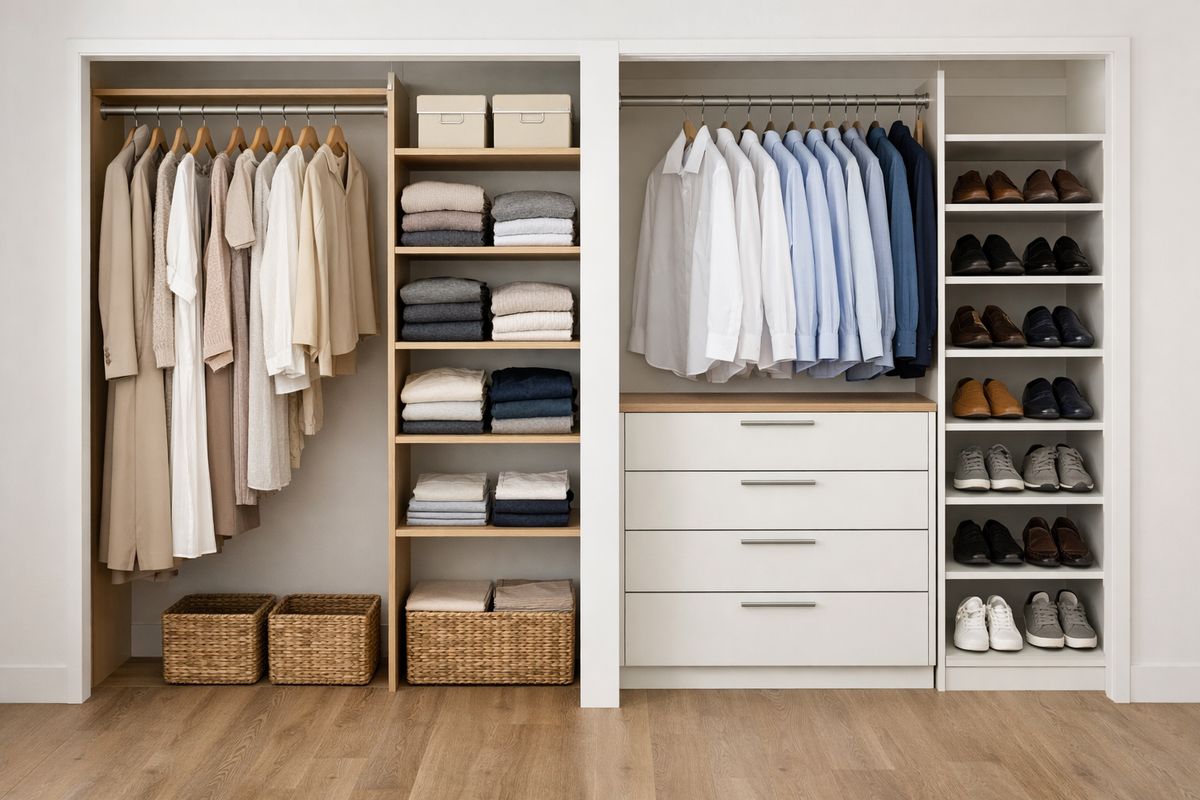
You get a menu of sizes, components, finishes, and features, but with enough flexibility to tailor the setup to your space and wardrobe. This route makes sense when you want more polish and better fit than a basic big-box system, but do not need every inch made from scratch.
For many homeowners, semi-custom hits the sweet spot between budget and performance.
Modular systems
Modular systems use standard components arranged in personalized ways. Good ones can be surprisingly effective, especially in straightforward spaces. Adjustable shelves, expandable rods, and add-on drawers make it easier to adapt the layout later.
Some of the better-known systems from brands like IKEA and ClosetMaid keep gaining ground because they balance value and flexibility. If you want a clean starting point for closet layouts that match your daily messes and routines, modular can absolutely work when the plan is thoughtful.
What a Personalized Closet Costs and What Affects the Price
Budget matters, and most people want a realistic sense of cost before making a call. Fair enough.
The price of a personalized closet depends far more on scope than on the label attached to it. “Custom” is not one price point. Neither is “modular.”
Typical price ranges you will see
A lot of closet projects land in the middle, not at the extremes. Industry data shows 81.3% of closet projects cost between $1,000 and $15,000. That is a wide range, but it reflects the fact that a simple reach-in upgrade and a premium walk-in are very different jobs.
At the higher end, premium custom systems often run about $2,500 to $10,000 or more per unit, especially when you add drawers, lighting, specialty hardware, and designer finishes. A basic modular setup can cost far less, but the total still depends on size and features.
What drives the cost up
Size is a major factor, but it is not the only one.
More drawers usually increase price faster than open shelves. Lighting, valet rods, pull-outs, hampers, glass fronts, and specialty accessory storage all add cost. Material choice matters too. Laminate is typically more budget-friendly than wood veneer or solid wood details. Fully custom fabrication and professional installation raise the total, especially in unusual spaces.
Labor and inflation also affect pricing in the real world. Recent industry reporting shows 74.3% increased prices in 2025, which helps explain why quotes can vary more than you expect.
Where you can save without ending up with another temporary fix
If you want to save wisely, keep the layout strong and simplify the extras.
Spend on the structure first: good proportions, enough hanging capacity, shoe storage that matches your wardrobe, and drawers where containment matters. Save on decorative upgrades if needed. A simpler finish can still perform beautifully. Open shelving can cost less than multiple cabinet fronts. Basic hardware often works just fine unless you are chasing a very specific look.
What you want to avoid is underbuilding the function and overspending on appearance. A pretty closet that still cannot handle your shoes is just a more expensive version of the same problem.
If pricing is your biggest question, breaking down what you are actually paying for helps separate real value from nice-to-have upgrades.
What the Design and Installation Process Usually Looks Like
The process is usually more straightforward than it sounds. Once you understand the steps, it feels a lot less mysterious.
Consultation and measurements
A consultation, in person or virtual, usually starts with your goals, your frustrations, and your inventory. Measurements are taken carefully, including dimensions, obstacles, and any quirks that could affect the design.
Some companies also ask about style preferences, finish choices, and whether you want mostly open or closed storage. If you are curious what a professionally designed option can look like, this custom closet example shows how features and finishes can come together in a real service offering.
Layout and feature planning
After measurements, the plan turns into zones. Hanging here, drawers there, shelves in this section, shoes in that section. Depending on the provider, you may get a sketch, a digital layout, or a 3D rendering.
This stage often includes revisions. That is normal. Sometimes you realize you need fewer shelves and more drawers. Sometimes you notice the original plan buried daily shoes too far from the entrance. Good planning is not about saying yes to every feature. It is about protecting the must-haves.
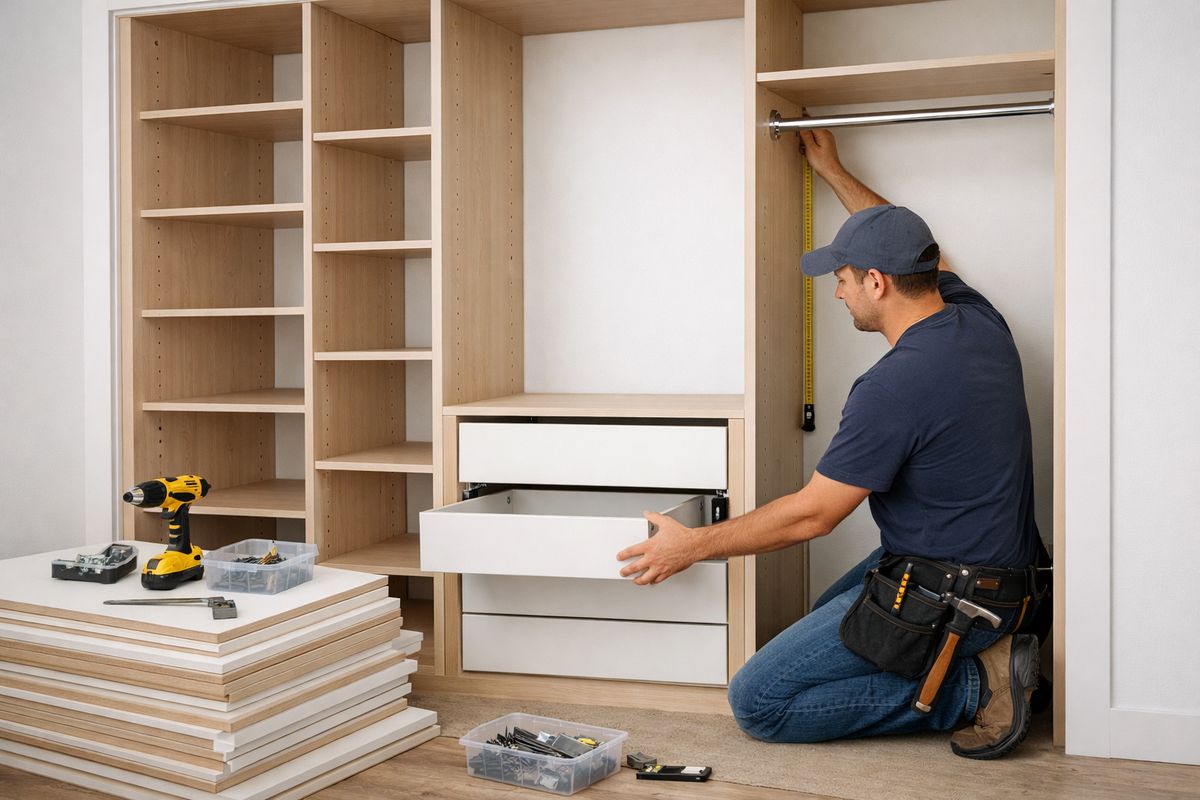
Build and installation
Timeline depends on the system type.
Some modular systems can be installed quickly once materials arrive. Semi-custom and fully custom closets usually take longer because fabrication happens after design approval. Simpler installations may be completed in a day. Larger walk-ins or more complex builds can take longer, especially if lighting or finish carpentry is involved.
This part is less dramatic than a kitchen remodel. In most cases, it is concentrated, fast-moving work.
Final setup and adjustments
Installation is not quite the finish line. The final step is seeing how the layout works with your real things.
That means hanging the right categories in the right places, testing drawer use, checking shelf spacing, and noticing whether anything feels slightly off. Sometimes a shelf moves. Sometimes a rod height gets adjusted. Sometimes you realize the handbag section needs more width than planned.
Those small tweaks are not a sign the design failed. They are part of making the closet truly fit your life.
Common Misconceptions About Personalized Closets
A lot of homeowners stay stuck because of a few assumptions that sound reasonable but are not really true.
“It is only for luxury homes”
No. Personalization is about fit, not status.
A reach-in closet in a regular bedroom can benefit just as much as a large walk-in. In some ways, smaller closets gain more because every inch matters more. The idea is not to create a showroom. It is to make storage work.
“You need a huge wardrobe to justify it”
You do not need a giant wardrobe. You need a mismatch between what you own and how the closet handles it.
Even a modest amount of clothing can feel chaotic in a bad layout. If folded items have no shelf depth that makes sense, or your daily shoes have nowhere to go, frustration shows up fast regardless of quantity.
“Custom means expensive and permanent”
Fully custom can be expensive, yes, but personalized does not always mean fully custom. Modular and semi-custom systems can still be tailored to your habits, your categories, and your space. Many also offer adjustability, which makes them less permanent than people assume.
That flexibility matters, especially as wardrobes and households change.
“A few bins can do the same job”
Bins are useful. Bins are not a layout.
That difference is easy to miss. A few containers can hold categories better. But if the underlying structure is wrong, bins just organize around the problem. A personalized closet fixes the structure itself.
Why More Homeowners Are Choosing Personalized Storage
This is not some tiny niche trend fueled by social media closet tours. More homeowners are making this shift because the problem is common and the payoff is immediate.
The shift from standard closets to tailored systems
Consumer preference has clearly moved toward storage that fits real needs. Research shows over 40% of households are shifting from standard closets to customizable systems, and nearly 45% of U.S. residential property owners prefer tailored storage solutions.
That shift makes sense because standard closets ask too much improvisation from you. Tailored systems reduce the guesswork.
Why remodeling and storage upgrades are growing together
Closet upgrades often happen alongside broader home improvements because storage changes how a home functions every day. It is not just cosmetic. Better storage supports cleaner rooms, faster routines, and less spillover into other spaces.
That connection is showing up in spending too. Harvard’s housing research points to record $524 billion in homeowner remodeling spending in early 2026. When people invest in making homes work better, storage naturally becomes part of the conversation.
What current trends say about where closets are headed
Current trends point in three clear directions: more flexibility, more sustainability, and selective smart features.
Adjustable layouts are getting more attention because lifestyles change. Sustainable materials matter more than they used to, especially lower-emission finishes and recycled content. Smart upgrades are showing up too, though the useful ones are still mostly practical, like better lighting and sensor-based convenience.
The overall market keeps growing as well. One report values the category at USD 33.7 billion and projects it to roughly double over the next decade. That growth says something simple: enough people have lived with frustrating closets long enough, and they are ready for a real fix.
How to Know if a Personalized Closet Is Right for You
Not every closet problem needs a full redesign. Some do. The key is knowing which kind of problem you actually have.
Signs your current closet is costing you time and energy
Some signals are hard to miss: piles outside the closet, clothes you forget you own, hard-to-reach upper shelves, repeated reorganizing that never sticks, shoes drifting into the bedroom, stressful mornings, drawers elsewhere in the house holding closet overflow.
If your closet is creating extra decisions, extra steps, and extra mess, it is costing you more than space. It is costing time and mental energy.
Questions to ask before you start shopping
Before you compare providers or products, get clear on the basics. How much hanging space do you truly need? What categories are hardest to store? Do you want open or closed storage? Does adjustability matter? Are finishes a priority, or is function the bigger goal? What budget range feels realistic?
You do not need every answer, but even rough clarity will make every quote and design conversation more useful. If you are still sizing up the problem, recognizing when a closet has crossed from annoying to unworkable can help.
When a simple reset is enough and when it is not
A simple reset may be enough if your closet already has decent bones and the issue is mainly too many neglected categories, poor folding habits, or unused vertical space. In that case, editing, reassigning zones, and adding a few smart components may solve more than you expect.
But if the structure itself is wrong, too little hanging, bad shelf spacing, no shoe storage, wasted height, awkward access, then no amount of tidying will make it behave. At that point, a new layout is the real solution.
Questions to Ask a Closet Company or Installer
Once you start talking to companies or installers, a few smart questions can save a lot of confusion later.
What is included in the design and quote
Ask what the quote actually covers. Measurements, design drawings, revisions, materials, hardware, installation, removal of old shelving, haul-away, touch-ups, warranty, all of it. Some quotes look lower because key pieces are missing.
Clear scope makes comparison possible.
How adjustable the system will be later
Ask what can be moved, resized, or reconfigured after installation. If your wardrobe changes, if the room changes use, or if you sell the home, adjustability may matter more than you think.
A rigid system can still be great, but you should know what you are buying.
What materials, finishes, and warranty options are offered
Material quality affects durability, appearance, and price. Ask what the shelves and drawers are made from, what finish options are available, and what warranty backs the work. Soft-close hardware, thicker panels, and better finishes may be worth paying for, but it helps to know the difference before you compare bids.
If you are evaluating providers, it also helps to know what to look for before picking an installer, especially if multiple quotes seem similar on the surface.
Try This Before You Make a Call
Before you talk to anyone, spend one week paying attention.
Notice what lands on the chair. Notice what gets buried. Notice what you avoid putting away because your closet does not handle it well. Write down five things your closet consistently fails to store properly, maybe ankle boots, folded jeans, worn-once clothes, handbags, or everyday jewelry. That short list will tell you more than any inspiration board.
A personalized closet is not really about shelves and rods. It is about removing the handful of daily annoyances that keep making your home feel harder than it should. Try that one-week exercise, and you will know exactly what needs fixing.
Frequently Asked Questions
Is a personalized closet the same as a custom closet?
Not always. Personalized is the broader idea, meaning the layout fits your needs. Custom usually means built specifically for your exact space. A modular or semi-custom system can still be very personalized if it is planned around your wardrobe and habits.
Can a small reach-in closet be personalized?
Yes, and small reach-ins often benefit the most. Double hanging, better shelf spacing, drawers, and smarter shoe storage can make a tight closet work much harder without changing the room size.
How much should you budget for a personalized closet?
A lot depends on size, materials, and features. Many projects fall between $1,000 and $15,000, while premium custom setups can go higher. The smarter way to think about budget is by scope: simple reach-in upgrade, midrange semi-custom, or fully custom walk-in.
Are personalized closets worth it if you plan to move later?
They often are, especially if your current closet creates daily frustration. A better closet improves how your home functions right now, and adjustable or broadly appealing designs can still make sense if your timeline is uncertain.
What features matter most in a personalized closet?
The most useful features are the ones that fix your actual pain points. For many closets, that means the right hanging mix, enough shelf and drawer space, practical shoe storage, and a laundry solution. Extras like lighting and valet rods help when they solve a real annoyance.
Do you need to declutter before designing a personalized closet?
You do not need a perfection-level purge, but you do need an honest inventory. The goal is to count what you really store and how you use it, so the closet is designed around reality instead of guesses.