


A his and hers closet is a shared closet designed for two people with different wardrobes, different routines, and usually very different frustrations. If your bedroom chair has become a second closet and weekday mornings feel like a low-grade argument with hangers, shelves, and shoe piles, the fix is not more bins. It’s a fairer setup, and fair has a very specific meaning here.
Why “Fair” Matters More Than “Equal” in a Shared Closet
The usual picture of a shared closet looks neat on paper: one side for you, one side for the other person, split right down the middle. But that setup falls apart fast if one side needs mostly hanging space and the other needs drawers, shelves, or room for shoes and bags. A perfect 50/50 line can still feel lopsided every single morning.
A fair his and hers closet is not about making both sides identical. It’s about making both sides equally usable. If one side gets more inches but the shelves are too high, the lighting is bad, and the everyday clothes are crammed behind formalwear, that side is not actually winning anything.
That distinction matters more than most people expect. Closet frustration is rarely about aesthetics alone. It shows up at 7:12 a.m., when one person is digging for a belt, the other is stepping around shoes on the floor, and the chair in the corner is holding three “not dirty, not clean” outfits. The quiet annoyance usually comes from one side simply working better than the other.
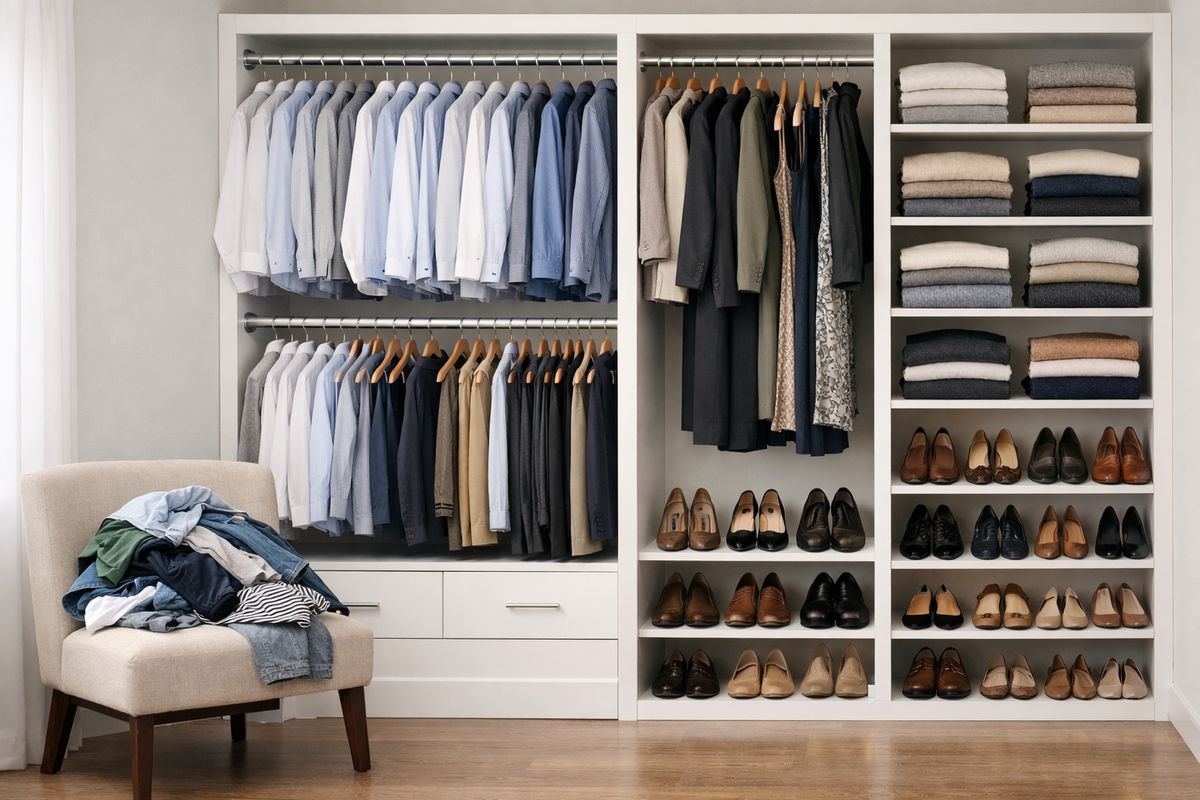
What a His and Hers Closet Actually Needs to Do
A shared closet has one job: make getting dressed easier for both of you. Looking good is a bonus. The real standard is function.
That means your closet should keep clothes visible, reduce clutter, stop overflow into the bedroom, and make daily items easy to grab without a scavenger hunt. It should also lower the number of tiny decisions you have to make before coffee. When everything has a place and that place makes sense, mornings get faster and the room feels calmer.
There’s an emotional payoff too, and it’s not imaginary. Better wardrobe organization has been linked to less decision fatigue and less anxiety in app-based wardrobe research, which tracks with real life more than you’d think. If you can see what you own, your brain stops treating the closet like a problem to solve before you’re even dressed.
It should match real life, not a showroom
The best closet layouts are a little unglamorous, honestly. They reflect how you actually live. Not how a catalog says people live.
If you wear work clothes five days a week, those items need prime access. If one side uses more folded sweaters, handbags, watches, or gym clothes, that side needs the right mix of shelves and drawers. If one person does laundry every few days and the other lets a hamper fill to the top, that habit affects where dirty clothes should go and how much backup storage your closet needs.
This is why generic inspiration photos can be misleading. Symmetry looks beautiful, but it often ignores the obvious. Your shoe volume is real. Your bags take up space. Your long coats and dresses do not magically shrink because the layout would look nicer with matching double rods.
It should give both sides equal convenience
Convenience is where fairness becomes visible. Both sides need easy access to everyday items, enough hanging room for the kinds of clothes actually worn, reachable shelves, and a dedicated home for the small stuff that usually disappears.
That might mean one side has more drawers while the other has more hanging sections. Fine. What matters is that both of you can get dressed without moving each other’s things, stretching for daily items, or storing overflow in random places around the room. If you want a deeper look at this balancing act, ending the closet tug-of-war starts with assigning convenience, not just square footage.
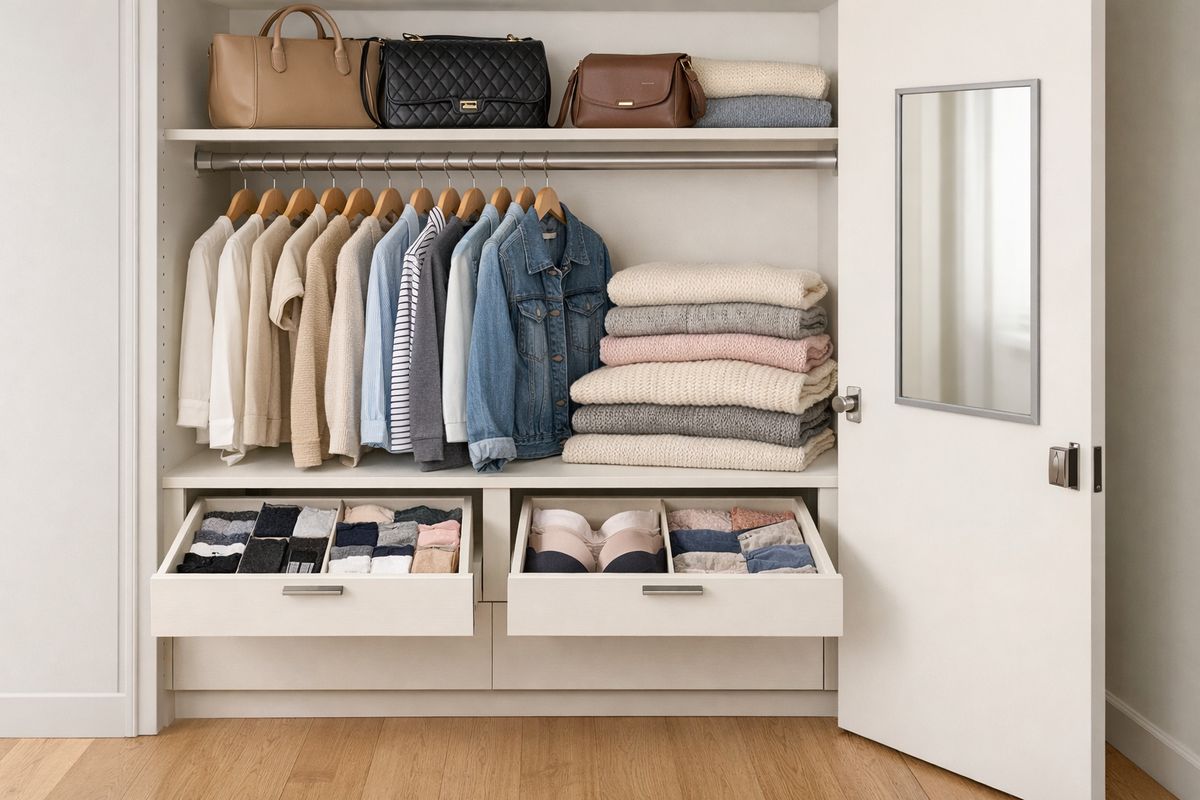
Start by Taking Stock of What You’re Really Storing
Before choosing rods, drawers, or pretty bins, take inventory. Not a spreadsheet-level inventory, just an honest count by category.
Look at how many long-hang items you have, such as dresses, coats, or dress pants that wrinkle easily. Count shorter hanging clothes, folded items, shoes, handbags, belts, jewelry, watches, hats, and laundry. The goal is not perfection. The goal is to stop guessing.
This step changes everything because most closet problems are really category problems. You don’t have a “messy closet.” You have too many boots with nowhere to stand, too many sweaters stacked in unstable piles, or too many small accessories hidden in three different baskets.
Separate daily-use items from rarely used items
Once your categories are clear, split them by frequency. What do you wear every week? What only comes out for weddings, vacations, or one random holiday party in December?
Everyday items belong at eye level or within easy reach. That includes workwear, favorite shoes, go-to handbags, underwear, socks, sleepwear, and the accessories you actually use. Occasion pieces can live higher up, farther back, or in less convenient zones.
This one move makes a closet feel smarter almost immediately. It’s the same logic as keeping your coffee mugs in the cabinet by the coffee maker instead of on the highest shelf across the kitchen. Prime real estate belongs to what your hand naturally reaches for.
Notice the storage troublemakers
Every shared closet has a few categories that break the system. Usually it’s boots, long dresses, bulky sweaters, handbags, belts, hats, or an ambitious shoe collection.
These are the things cheap organizers rarely solve. Sweaters slump. Boots collapse. Handbags get crushed on a top shelf. Belts knot together in a drawer. Shoe racks multiply but still leave pairs on the floor.
When you identify your troublemakers early, your layout gets more honest. Instead of buying another organizer that sort of fits, you can build a section that actually handles the category. That’s the difference between temporary relief and a closet that still works six months later.
Stop Splitting the Closet Down the Middle by Default
Here’s the thing: fair doesn’t have to look symmetrical. In fact, the closer you force symmetry, the more likely you are to create inconvenience.
An exact split usually assumes both of you store the same kinds of things in the same proportions. Almost nobody does. One side might need mostly double-hang rods for shirts and pants. The other might need a long-hang section, more shoe shelving, and several drawers for smaller items. Drawing an imaginary center line and calling it done is usually where the trouble starts.
Divide by wardrobe type, not just square footage
A better approach is to divide the closet by category needs. If one side has twenty pairs of dress shoes and the other has five, the shoe storage should reflect that. If one side wears more suits, blouses, or wrinkle-prone items, that side needs more hanging room. If one side relies on folded knits, workout wear, and accessories, shelves and drawers should take the lead.
This also helps you avoid lazy “his side” and “hers side” assumptions. Plenty of closets get designed around stereotypes instead of reality, which is how you end up with too little accessory storage for one person and too many unnecessary rods for the other. Build around use. Always.
Keep the visual balance without forcing equal dimensions
Different layouts can still look cohesive. Matching finishes go a long way. So do repeated shelf lines, consistent storage bins, the same hanger color, and mirrored lighting or hardware.
This is how a shared closet can feel calm instead of cobbled together. You can keep the look balanced even if one side has three drawers and the other has none. From across the room, it still reads as one intentional space. Up close, it works the way your life actually works. If you’re comparing systems, the difference between off-the-shelf pieces and a built-for-you setup usually comes down to this kind of fit.
Choose the Right Layout for Your Space
Layout decides whether a shared closet feels workable or cramped. The same storage pieces can feel great in one footprint and terrible in another, so shape matters.
Your biggest concerns are simple: can both of you reach what you need, can you move around without bumping into each other, and can the closet support your actual storage mix? That sounds basic, but it rules out a lot of bad ideas quickly.
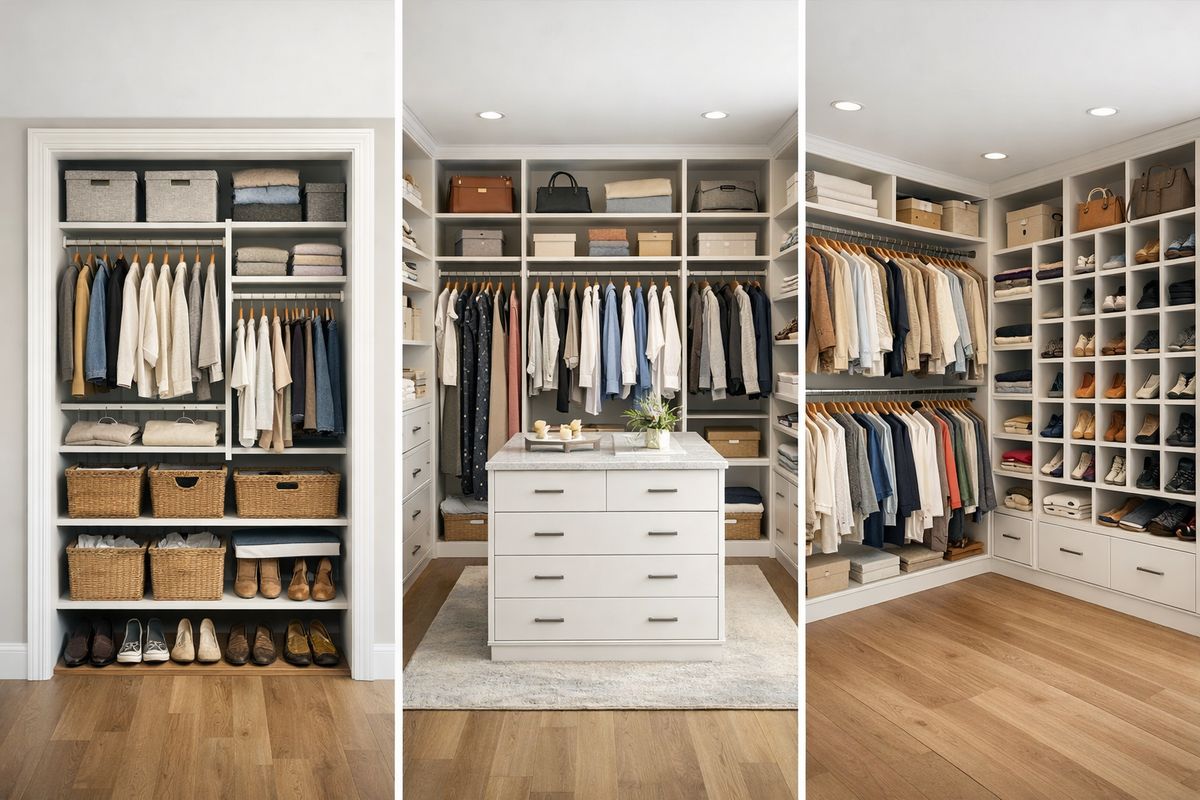
Reach-in shared closet ideas
A reach-in closet has less room to waste, so every inch needs a job. Stacked rods often help, especially for shorter hanging clothes. Upper shelves can hold less-used items or labeled bins. Slim drawers work well for socks, undergarments, jewelry, and sleepwear if your closet depth allows them. Over-door storage can be useful for accessories, but only if it doesn’t turn into a visual junk drawer.
Seasonal rotation matters more in a reach-in. If your heavy coats, formalwear, or out-of-season shoes live somewhere else part of the year, the everyday closet gets much easier to share.
Fairness in a small closet usually means one side gets more vertical hanging while the other gets more shelves or drawers. Tight spaces reward honesty. If you pretend both of you need the same setup, the floor will tell on you.
Walk-in his and hers closet ideas
A walk-in gives you more flexibility, but it also makes overbuilding easier. More square footage does not automatically mean better function.
Separate walls can work well if your wardrobes are roughly similar in volume. A shared center island helps if both of you need drawers for smaller items. One wall can focus on hanging while another handles folded clothes, shoes, and accessories. The trick is to preserve visibility and movement. If the center of the closet is so crowded that you have to sidestep each other to open a drawer, the layout is fighting you.
For many homeowners, this is where a storage plan shaped around your actual habits starts making more sense than another round of add-on organizers.
L-shaped and galley-style closet setups
These shapes often solve shared storage better than a straight rectangle because they create natural zones. An L-shape can give one side a longer hanging wall while the other takes a shorter wall with more shelving. A galley setup, with storage on two facing sides, can make a clear division without enforcing a rigid 50/50 split.
These layouts work especially well if your storage needs differ a lot. One person can have a wall dedicated to hanging and shoes while the other gets more drawers, shelves, and accessory storage. The shape itself helps define the zones, which means less need for forced symmetry.
Build Zones Around How You Get Ready
Storage categories matter, but routine matters just as much. A closet can have all the right components and still feel annoying if it ignores how you move through your day.
The easiest way to fix that is to build zones around actual habits. Morning rush, after-work change, laundry drop, tomorrow’s outfit, weekend wear. Your closet should support those moments, not add friction to them.
Create a grab-and-go zone
This is the part of the closet for the things you reach for constantly. Favorite work shoes. The bag you use most weekdays. A belt, watch, or jewelry tray. The two pairs of pants that somehow carry half the week.
Keep these items together and easy to see. That saves more time than fancy storage ever will because it cuts out the tiny delays that stack up in the morning. If your most-used items are scattered across the closet, getting dressed turns into a hundred little interruptions.
Add a drop zone for the in-between items
Most closets fail because they only plan for clean and dirty. Real life has a third category: worn once, not ready for the hamper, but definitely not going back in with fresh laundry.
Give those items a home. A valet hook, a shelf, a small open section, or even one dedicated rod can handle tomorrow’s outfit, dry cleaning, a blazer worn for two hours, or the bag that comes in and out with you every day. Without that zone, the chair in the bedroom becomes the default. You already know how that ends.
Plan a hidden-but-handy hamper area
Hamper placement matters more than it seems. If the hamper is awkward to reach, too small, or steals space from more useful storage, laundry starts drifting.
The best spot is easy to use but tucked out of the main path. Pull-out hampers, lower cabinets, or side-by-side bins can work well, especially if you sort lights and darks. The point is simple: dirty clothes should have a fast landing place that does not block movement or eat up prime hanging space.
Storage Features That Make Shared Closets Work Better
The right storage pieces fix specific problems. The wrong ones just add more containers to your life.
A fair shared closet usually needs a mix of hanging, folding, drawers, and visible accessory storage. Not because it sounds organized, but because different clothing types behave differently. Your closet should respect that.
Double-hang rods, long-hang sections, and shelf towers
Double-hang rods are two levels of hanging space, usually for shirts, folded-over pants, skirts, or shorter jackets. They are great when you have lots of shorter items and not much floor space.
Long-hang sections are the opposite. They give full vertical room for dresses, coats, long cardigans, or anything that wrinkles when folded. Shelf towers are stacked shelves that work for sweaters, jeans, handbags, or bins.
The best closets combine these on purpose. A shared closet with only hanging rods wastes opportunities for folded storage. A closet with too many shelves turns into piles. Mixing these elements creates a layout that fits what you actually own. If you’re trying to picture what that mix looks like in practice, seeing what a built-in storage system actually includes helps.
Drawers for small items you’re tired of losing
Drawers are not glamorous, but they solve a ton of daily irritation. Socks, undergarments, workout gear, sleepwear, watches, and jewelry all behave better in shallow, dedicated drawers than on open shelves.
Visibility is the real benefit. Small items stop drifting. Categories stay stable. You stop buying another pack of black socks because the old ones vanished into a pile somewhere.
Shoe storage that doesn’t turn into floor clutter
Shoe storage is where many shared closets win or lose. Angled shelves make pairs easy to see. Flat shelves work well for stacked rows if the height is right. Cubbies help when you want strict boundaries, though they can waste space if sizes vary. Boots need taller compartments or supports, otherwise they slump and eat floor space.
Good shoe storage improves the whole closet because shoes are usually the first category to spill out. Once pairs live on the floor, movement gets tighter, cleaning gets harder, and the closet starts feeling more chaotic than it is.
Open display vs closed storage
Open shelves make things visible. Closed drawers and cabinets hide visual noise. You need both.
Use open storage for items you want to see and reach easily, like everyday shoes, folded jeans, or handbags you rotate often. Use closed storage for items that look messy fast, such as undergarments, workout gear, sleepwear, and small accessories.
The balance matters. Too much open storage makes the closet feel busy. Too much closed storage makes it easy to forget what you own. Research on wardrobe tools has found that better visibility is one of the biggest reasons organized systems feel useful in daily life.
Make Accessories Easy to See, Not Easy to Forget
Accessories are usually treated like leftovers. Then they disappear.
If belts, scarves, ties, jewelry, or bags do not have dedicated storage, they end up hidden, tangled, or forgotten. And hidden accessories tend to become unused accessories.
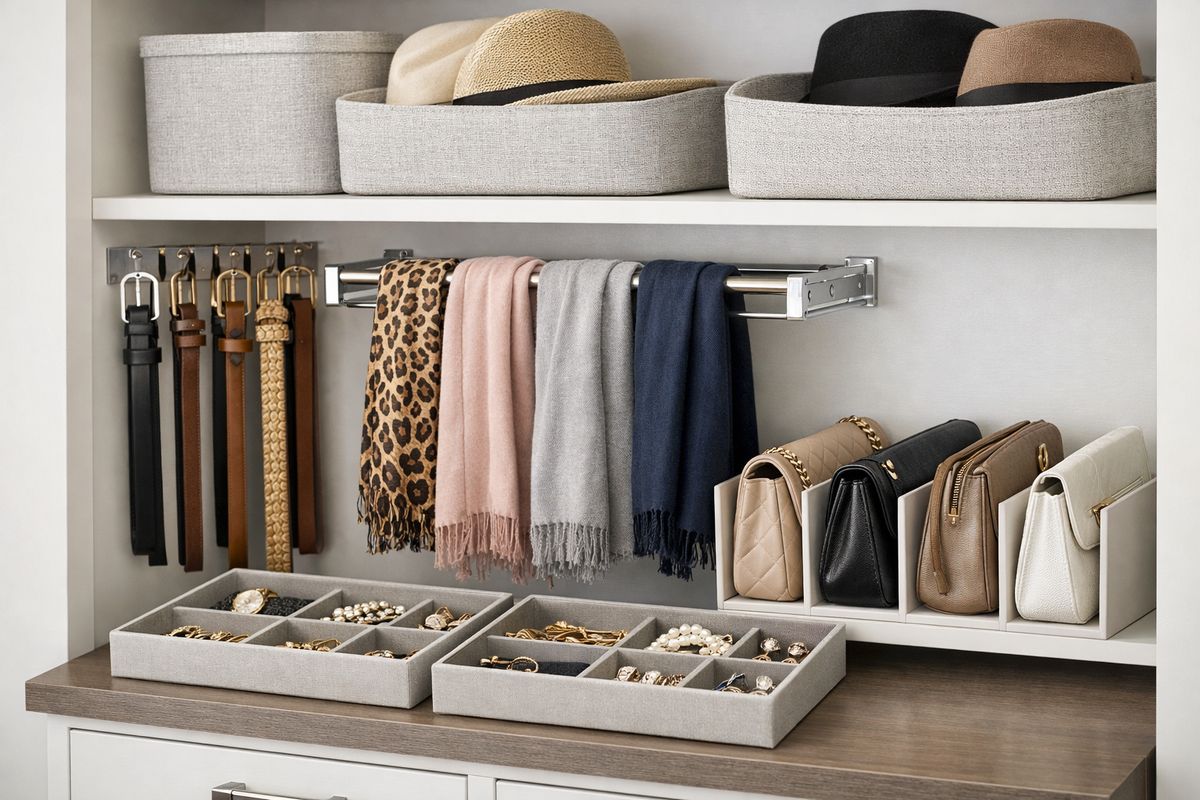
Belts, ties, scarves, and jewelry
Hooks, pull-out racks, divided trays, and shallow drawers all work because they make small items visible without creating clutter. The best choice depends on whether you want to see everything at once or keep it dust-free and tucked away.
The practical goal is simple: faster outfit decisions. If your belt options are hanging in plain view or your jewelry is sorted in a tray instead of piled in a box, you use more of what you already own and spend less time digging.
Bags, hats, and bulkier extras
Larger accessories need structure. Top shelves can work for bags and hats if you use bins or dividers to keep them upright. Cubbies are helpful when you want each bag to have a clear home. Structured bins with labels are useful for seasonal hats, evening bags, or travel extras.
What you want to avoid is crushing these items into leftover corners. That steals hanging space, wrinkles nearby clothing, and guarantees half your accessories fade into the background.
Use Vertical Space Without Making the Closet Hard to Maintain
Building up instead of out is smart, but only up to a point. A closet is not successful just because it stores more. It has to stay usable.
Tall systems can be excellent for off-season storage, travel gear, and less-used items. But if your everyday closet depends on a step stool and perfect memory, you’ve traded clutter for inconvenience.
What belongs up high
High shelves are best for off-season clothing, keepsakes, travel bags, extra bedding, formalwear, and backup storage like spare handbags or rarely worn shoes. Keep these items light, clearly contained, and easy to identify from below.
This is also a good place for bins with labels, especially if you rotate wardrobes by season. That way your daily area stays focused on what you actually wear right now.
What should stay between shoulder and knee height
This is your prime real estate. The things you use most should live where your hand naturally lands: between shoulder and knee height.
That includes work clothes, favorite casual pieces, daily shoes, bags, socks, underwear, and high-use accessories. Follow that one rule and your closet gets easier almost immediately. Ignore it and you’ll spend every morning reaching past formalwear to get to your actual life.
Small Design Details That Prevent Daily Friction
Little details don’t stay little once you use the closet every day. They become either helpful habits or recurring annoyances.
This is where a shared closet stops being just storage and starts becoming a functional part of your routine.
Lighting, mirrors, and a place to actually get ready
Bad closet lighting makes everything harder. Colors look off. Dark corners hide clothing. Getting dressed becomes guesswork.
Better lighting, especially inside shelves or above hanging sections, makes the whole closet feel more usable. Add a mirror and you turn the closet into part of the getting-ready process instead of just the storage stage before it. Even one slim mirror can save trips back and forth to the bedroom or bathroom.
Keep the floor clear on purpose
A clean closet floor is not the result of superior discipline. It’s usually the result of having the right categories above it.
If shoes, laundry, bags, or in-between clothes are ending up on the floor, that usually means they don’t have a real home. Add the missing shelf, basket, hamper, or lower shoe section and the floor clears itself. This is one of the clearest signs that a layout is working.
Labeling and simple category rules
You do not need a label maker obsession to keep a closet stable. A few simple labels on top bins, accessory boxes, or seasonal storage can do the job.
Matching hangers help more than people expect because they make spacing consistent and keep the closet visually calmer. A few shared rules help too: shoes go back on shelves, not the floor; in-between clothes go on the valet hook, not the chair; laundry goes in the hamper immediately. Keep it light. The point is to make resetting the space easy, not to turn your closet into a school hallway.
Common His and Hers Closet Mistakes to Avoid
Most closet problems do not come from lack of effort. They come from solving the wrong problem.
That’s why it’s so common to spend money on organizers and still feel annoyed by the space a month later.
Buying organizers before measuring your wardrobe
Random bins, shelf inserts, and trendy accessory racks can be useful, but only after the layout makes sense. If you haven’t measured what you own by category, those products are just guesses with good packaging.
This is why so many closets end up full of stuff that organizes the wrong thing beautifully. A better approach starts with volume and habits, then chooses storage pieces to match.
Giving one side more space but worse access
Fairness includes convenience. A side with more width but awkward shelves, poor lighting, and daily items stored too high will still feel unfair.
The test is not “who has more inches.” The test is “can both of you get dressed easily?” If the answer is no, the layout needs adjusting.
Ignoring maintenance after the big reset
Even a great closet needs a small amount of upkeep. The catch is that the upkeep should be easy.
The best system is the one you can maintain in five minutes during a busy week, not the one that looks amazing for two days after a reorganization spree. Fewer categories, clearer zones, and easier access all make maintenance more realistic. That matters a lot more than perfection.
Custom vs Modular: Which Kind of Closet System Makes Sense?
You generally have two paths: modular or custom. Modular means a system made from pre-sized components that can be arranged and adjusted. Custom means the design is built specifically for your space and your storage mix.
Neither path is automatically better. The right one depends on the room, the volume of clothing, and how different your needs are from each other.
When modular systems work well
Modular systems are often a smart choice for reach-ins, smaller walk-ins, or straightforward layouts. Adjustable shelves, add-on drawers, and flexible rod placement can still feel intentional if the base plan is solid.
This is especially true if your closet dimensions are standard and your needs are fairly easy to map. Modular systems can stretch a budget while giving you more structure than freestanding organizers ever will.
When custom closet design is worth it
Custom design earns its price when your room has awkward dimensions, your wardrobe volume is high, or your needs are very different from each other. Sloped ceilings, unusual corners, deep walls, weird alcoves, and mixed storage needs are where custom work starts to make real sense.
Closet companies are leaning hard into this category for a reason. Industry reporting shows closet systems were 79.3% of top-selling projects for closet firms in 2025, which tells you homeowners are investing in built-in solutions, not just buying another shelf insert. If you want to see what that route looks like, custom-built closet options show how tailored layouts solve category-specific problems better than one-size-fits-all kits.
Questions to answer before you call a pro
Before getting estimates, get clear on what’s wrong now. Where does overflow land? Which categories cause the most friction? How many shoes do you want accessible at one time? Do you need laundry built in? Does one side need more long hanging, more drawers, or better accessory storage?
Also decide which daily annoyances you want gone first. That answer matters more than the finish color. If you’re still deciding whether your situation has crossed the line from annoying to worth fixing, the signs that your closet setup has outlived its usefulness are usually pretty obvious once you name them.
Why Better Closet Organization Pays Off Beyond Storage
A good closet does more than hold clothing. It changes how you use what you already own.
That sounds lofty for a storage project, but the effects are practical. Better visibility, easier access, and clearer categories make your wardrobe easier to manage and easier to trust.
Better visibility can cut duplicate buying
If you can’t see what you own, you’ll forget what you own. That’s how you end up buying another black sweater that looks suspiciously like the one stuffed behind a stack of jeans.
Wardrobe research has found that reduced overconsumption and greater use of existing clothing show up when people have better systems for tracking and seeing their wardrobes. A physical closet works the same way. Visibility keeps you from shopping blind.
A calmer closet can reduce stress
Closet stress is a low-level drain, but it’s still a drain. Repeatedly hunting for things, moving piles around, or feeling crowded before your day starts wears on you.
Organized wardrobe systems have also been associated with mental clarity and reduced anxiety, which makes sense. When the space is easier to use, your mornings ask less from you. Not magic. Just less friction.
A smarter closet can help you use more of what you already own
There’s also a practical waste angle here. The fashion industry produces an enormous amount of clothing, with 92 million tonnes of textile waste generated annually. Your closet won’t solve that alone, of course. But better organization does make it easier to rotate clothing, remember forgotten items, and stop good pieces from disappearing into the back corner.
And once you can see what you have, you’re more likely to wear it.
His and Hers Closet Ideas by Priority
Sometimes the fastest way forward is to stop thinking about the whole closet and identify the one problem that annoys you most.
That gives you a useful starting point.
If your biggest issue is not enough space
Use more vertical storage, add double-hang rods where possible, rotate seasonal items out of the main closet, and make shoe storage more deliberate. A lot of “not enough space” problems are actually “too much wasted height” problems.
If your biggest issue is morning chaos
Create a grab-and-go zone, make accessories visible, add better lighting, include a mirror, and carve out one spot for tomorrow’s outfit. Morning stress usually comes from scattered daily items, not total lack of storage.
If your biggest issue is one person taking over
Remeasure by category, not by assumption. Then rebalance convenience, not just width. Dedicated zones work better than vague ownership. If one side constantly spills over, the closet is telling you the current split is fake fairness.
If your biggest issue is keeping it organized
Use fewer categories, easier hamper access, more visible storage for high-use items, and a simple five-minute weekly reset. Overly complicated systems collapse fast. Simple systems survive busy weeks.
What to Try This Week Before You Redesign Anything
Before buying a single organizer, spend 20 minutes sorting your closet into rough categories. Hanging clothes, folded clothes, shoes, bags, accessories, laundry, and the in-between stuff. Then mark what you use every week and what could live higher up, farther back, or somewhere else entirely.
That one exercise will show you what fair should actually look like. Not showroom fair. Real-life fair. And once you can see that clearly, the next decisions get much easier.
Frequently Asked Questions
How much space should each person get in a his and hers closet?
Not automatically half. Each person should get space based on wardrobe type, volume, and daily use, with equal convenience built in. One side may need more drawers while the other needs more hanging room.
Can a his and hers closet work in a small reach-in closet?
Yes, if the layout is honest. Small shared closets work best with stacked rods, slim drawers, upper shelves, seasonal rotation, and clear zones for high-use items. In a tight space, thoughtful storage matters more than symmetry.
What is the biggest mistake in shared closet design?
Splitting the closet down the middle without checking what each side actually stores. That looks fair at first, but it often creates daily frustration because the storage types don’t match the wardrobe.
Is a custom closet worth it for a shared space?
It can be, especially if your room has awkward dimensions or your storage needs are very different. Shared closets benefit a lot from tailored layouts because fairness depends on fit, access, and category-specific storage.
How do you keep a his and hers closet organized after setting it up?
Keep the system simple. Give daily items easy access, create one drop zone for in-between clothes, use a handy hamper, and do a quick weekly reset. The easier the system is to maintain, the longer it lasts.
What should go at eye level in a shared closet?
The things you use most: workwear, favorite casual pieces, daily shoes, bags, and high-use accessories. Prime space should go to high-frequency items, not formalwear or off-season clothing.