


If you keep wondering whether you really need a custom closet, the answer usually shows up at 7:15 a.m., when you’re moving hangers aside with one hand and digging for a shoe with the other. The phrase “need a custom closet” sounds dramatic until your current setup starts wasting time, crowding other rooms, and making simple routines feel harder than they should.
What “Needing a Custom Closet” Actually Means
Needing a custom closet does not mean you want something fancy for the sake of appearances. It means your current storage no longer fits your space, your wardrobe, or your daily routine, and the mismatch is causing repeat friction. A custom closet is simply a storage setup built around your actual dimensions and habits instead of forcing your life into a generic rod-and-shelf box.
That can mean a full built-in installation with drawers, shelves, accessory storage, and lighting. It can also mean a semi-custom or modular system tailored to your measurements, your mix of hanging and folded clothes, and the awkward details of your room. The real idea is simple: the closet should fit you, not the other way around.
That definition matters because a lot of homeowners picture a showroom walk-in with glass doors and boutique lighting, then assume custom is excessive. But custom can be as practical as adding double hanging where you need it, deeper shelves for sweaters, and one drawer that finally gives socks and workout gear a home.
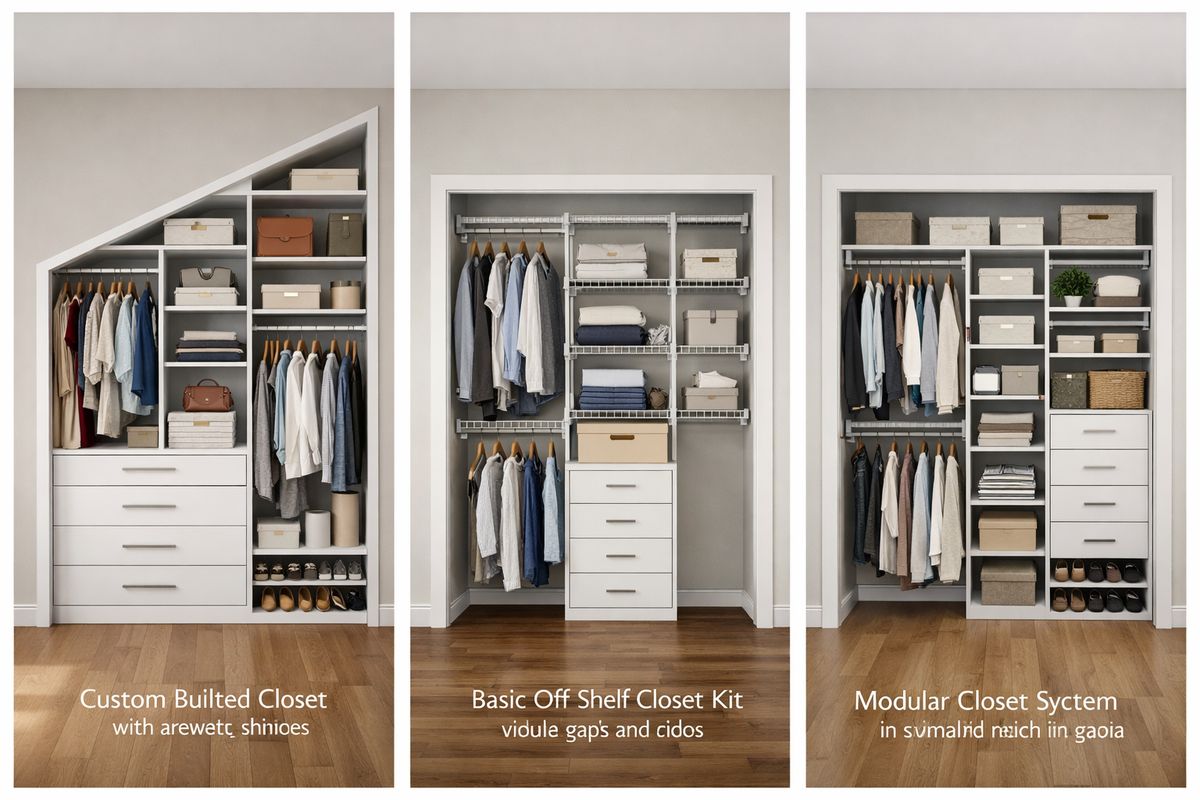
Custom vs. prefab vs. modular
A fully custom closet is built specifically for your space. Every section is planned around exact wall lengths, ceiling height, trim details, corners, and storage needs. If your closet has odd angles, a sloped ceiling, weird setbacks, or just a very specific mix of clothes and accessories, this is the version that solves the problem most completely.
A prefab closet is the basic off-the-shelf option. You buy a kit, install it, and work within the dimensions and components that come in the box. That can be enough in a simple reach-in, but it often leaves wasted inches, awkward gaps, and the same old categories fighting for the same shelf.
Modular sits in the middle. You start with standardized pieces, but you combine them in a way that better matches your layout and your storage habits. For some homes, that middle ground is the sweet spot. In fact, lower-cost modular options have expanded because the market has shifted toward affordable customization, including kits under $1,000 for homeowners who want more function without going all the way to a fully custom build.
So the question is not “custom or nothing.” The better question is this: what level of customization will fix the problem for good?
Why this question comes up after years of trying to make do
Here’s the thing: almost nobody starts here. You start with bins on the floor. Then matching hangers. Then shelf dividers. Then maybe a shoe rack, a sweater organizer, an over-the-door hook system, and a few baskets that looked promising online.
For a month, it feels better.
Then the chair in your bedroom turns back into the “not dirty, not clean” chair. The top shelf becomes a pile of handbags and extra linens. Boots drift to the floor. The laundry basket lingers because putting clothes away feels like solving a puzzle every single time. If that sounds familiar, that’s not laziness. That’s a layout that never really worked.
That’s why this question tends to show up after years of trying to be more disciplined. Daily frustration has a way of making the real issue obvious.
The Fast Gut Check: Is Your Closet Annoying or Actually Failing?
An imperfect closet is normal. A failing closet is different. If your closet creates repeat stress every single week, slows down routines, and causes clutter to spill into other parts of your home, that is a storage problem, not a personal discipline problem.
That distinction matters more than it seems. Plenty of people blame themselves for being messy when the actual problem is structural: one rod, one shelf, dead air above eye level, no drawers, no zones, no home for shoes, bags, denim, or laundry. You cannot organize your way out of a system that was never designed for what you actually own.
A closet problem is usually a systems problem
Most closet frustration comes down to layout. You may have too much single-hang space and not enough folded storage. You may have a rod that runs the full width when half of it should be double-hang. You may have one high shelf that’s technically storage but practically a black hole.
Systems problems show up as visual clutter, but the root issue is usually poor use of vertical space, bad visibility, missing categories, or awkward access. If belts vanish, shoes stack on top of each other, and sweaters live in unstable piles, your closet is not supporting your routine.
That is why a better setup built around your habits tends to work better than another round of add-ons. Storage gets easier when the structure makes sense before you start filling it.
Why more bins rarely solve the root issue
Bins are useful, but bins on top of a broken layout are still a broken layout. If your closet has wasted corners, one unreachable top shelf, and a rod placed in the least flexible spot possible, adding more containers mostly hides the problem for a while.
The catch is that bins can even make access worse. Once categories get stuffed into unlabeled containers or stacked behind each other, visibility drops and friction rises. You stop seeing what you own. You forget what’s clean. You buy duplicates. Then the closet feels full and chaotic, even if a decent amount of space is technically still there.
A closet that works should reduce decisions, not create more of them.
Sign #1: You Can’t Put Laundry Away in One Pass
This is one of the clearest signs it’s time. If clean clothes regularly sit in baskets, on the bed, or over a chair because there is no obvious home for them, your closet has a category problem and a capacity problem.
Laundry tells the truth fast. A functional closet lets you sort, hang, fold, and finish. A failing closet turns clean clothes into temporary piles that linger for days because every item needs to be negotiated. Where do the leggings go? Which shelf can still hold sweaters without collapsing? Are those jeans supposed to be folded, hung, or stuffed into that half-open drawer?
When putting laundry away feels harder than doing the laundry, the storage system is not doing its job.
What this usually points to
Usually, this means your closet is missing enough dedicated zones. Maybe there are not enough shelves for folded items, not enough drawers for smaller categories, or not enough double-hang sections for everyday clothes. Maybe dress clothes, casual clothes, and out-of-season items are all competing for the same space.
It can also mean your closet has the wrong type of storage, not just too little of it. A single long-hang section for dresses is helpful, but not if it eats up space better used for shirts and pants. One deep shelf sounds generous, but it often creates hidden stacks instead of useful storage.
Editing your wardrobe can help, but if your core categories still do not have homes, the problem comes right back.
What a better setup changes
A better setup makes laundry boring again, which is exactly what you want. Everyday tops hang in one zone. Folded denim gets a shelf or drawer that can handle the volume. Workout clothes, sleepwear, undergarments, and accessories each get one clear place.
Then you can put everything away in one pass and move on.
That may sound small, but it changes the whole weekly rhythm of your bedroom. Less reshuffling. Fewer temporary piles. Fewer moments where your bed becomes a staging area for decisions you don’t want to make at the end of a long day.
Sign #2: You’re Wasting a Lot of Vertical Space
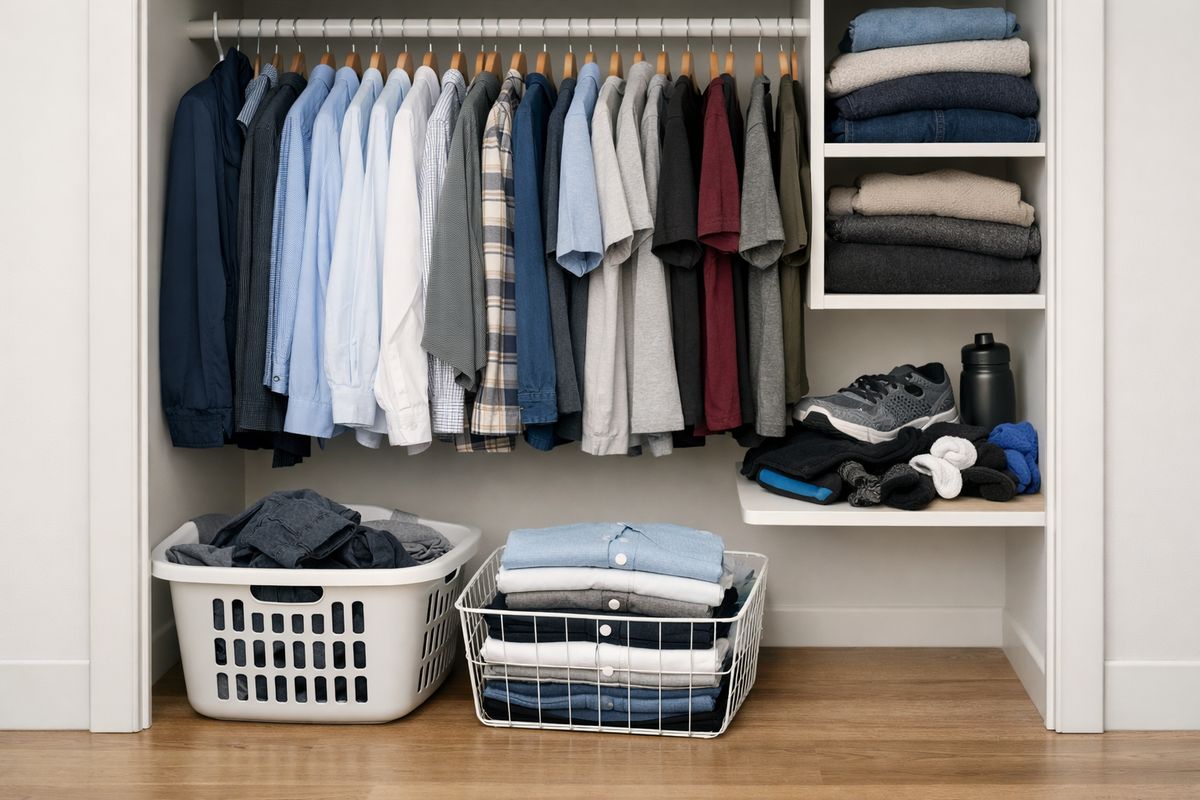
Many closets are built with one rod and one shelf, then left to fend for themselves. The result is a huge block of unused height that does nothing while the floor gets crowded and the shelf turns into a leaning tower of bags and folded clothes.
This is one of the strongest practical reasons to upgrade because the space already exists. You are not trying to create square footage out of thin air. You are trying to make the square footage you already have finally work.
And yes, it can make a major difference. Research on closet efficiency notes that multi-tier hanging rods can increase storage capacity by up to 50% in standard closets. That’s not a styling trick. That’s basic geometry finally doing something useful.
Common signs of wasted height
You can usually spot wasted vertical space in seconds. Handbags are jammed on the top shelf because there’s nowhere else for them to go. Boots crowd the floor. Sweaters are stacked too high because you only have one usable shelf. Seasonal items end up in the guest room, hall closet, or laundry room because your bedroom closet can’t absorb them.
There is also the dead-air problem. You look up and see 24 to 36 inches of empty space above the rod, but nothing there is accessible or assigned. That empty area feels harmless until you realize your whole room is paying for it somewhere else.
Custom features that solve this
This is where custom planning earns its keep. Double hanging turns one tall hanging section into two useful ones for shirts, skirts, and folded-over pants. Upper cabinets or upper shelves can hold off-season pieces, luggage, or lesser-used items. Adjustable shelving lets your closet evolve instead of locking you into one guess forever.
Valet rods help with outfit prep and dry cleaning. Pull-down rods can make high storage usable instead of decorative. Corner solutions can reclaim awkward areas that prefab kits often ignore. Even a small reach-in can gain a surprising amount from these changes.
If you want a clearer picture of what these changes look like in real spaces, it helps to browse smart layout ideas that reduce daily mess and notice which features solve problems you already have.
Sign #3: Your Closet Only Works If You Keep Very Few Things
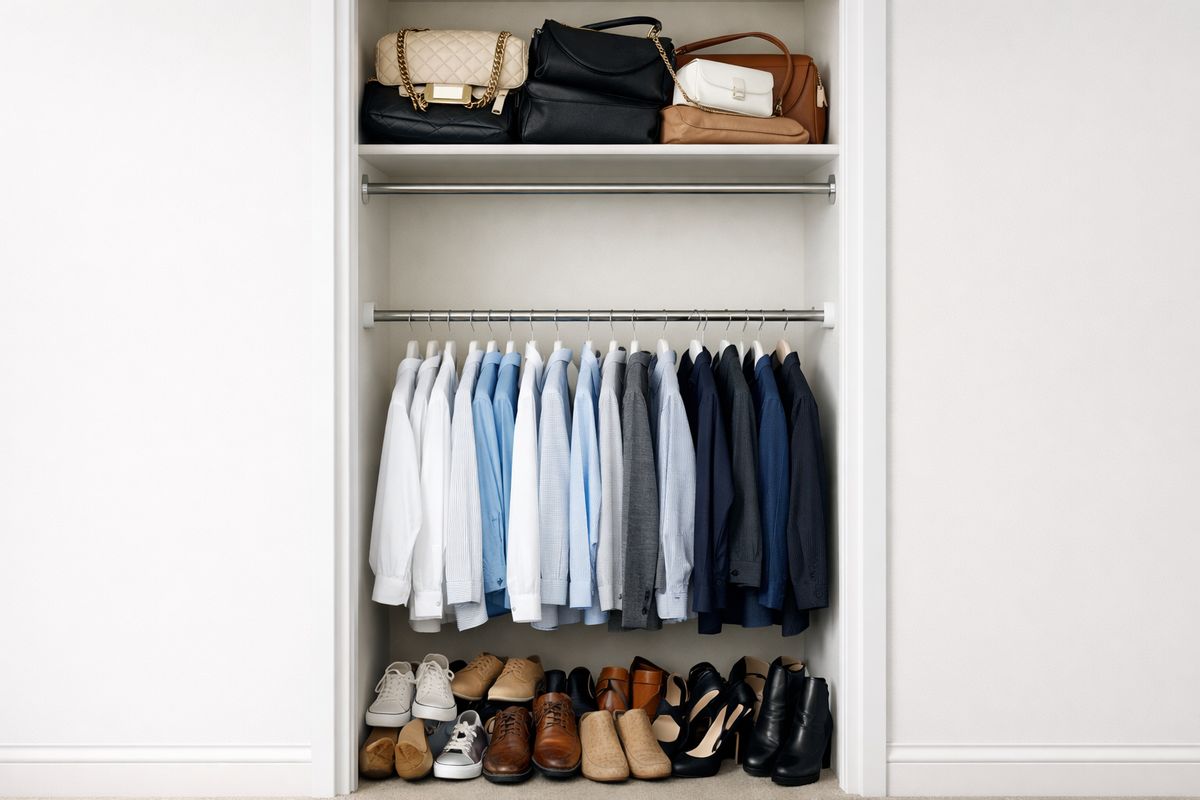
A lot of builder-grade closets function well only under one condition: you own almost nothing. That may have worked years ago. It may not work now.
If your real life has outgrown the original layout, your closet is functionally undersized even if the room itself is not small. That distinction matters. A closet does not need to be tiny to be inadequate. It just needs to be badly matched to what you actually store.
Life changes that often trigger this point
Life changes are often what expose the gap. Maybe work shifted from fully in-office to hybrid, and now your closet needs room for polished workwear, casual home clothes, and workout gear. Maybe hobbies brought in golf clothes, hiking layers, luggage, dancewear, or craft supplies. Maybe aging in place means you need easier reach zones and less bending.
Sharing is another big one. Once a partner enters the picture, a closet that felt merely annoying can become impossible. One person hangs almost everything. The other folds more. One needs long-hang space. The other needs drawers and shelves. Without clear zones, conflict sneaks in through the smallest daily moments.
Downsizing other storage can trigger this too. If a dresser left the room, a guest room changed function, or seasonal storage moved elsewhere, your closet may now be carrying more than it was ever designed to hold.
Why “purging more” is not always the answer
Purging helps when you truly have excess. But “just get rid of more stuff” is often used as a substitute for solving the layout problem, and that gets old fast. If you wear the clothes, use the bags, need the linens, and rotate the shoes, getting rid of half your things does not magically create better categories or easier access.
The trick is to separate volume from structure. Yes, too much volume can overwhelm any closet. But a bad structure can make a reasonable amount of stuff feel chaotic. You can edit aggressively and still end up with belts draped over hooks, denim piled on a shelf that’s too shallow, and handbags perched in a hard-to-reach row you never use properly.
A good closet should support the life you actually live, not a stripped-down fantasy version of it.
Sign #4: Your Mornings Feel Slower Because You Can’t See or Reach What You Need
This sign often gets dismissed because it feels minor. It isn’t. If your mornings are slower because you can’t quickly see, reach, or trust what’s in your closet, your storage is actively interfering with your routine.
You know the moments. Digging for a belt behind hanging shirts. Moving three shoe boxes to reach one pair you actually wear. Forgetting about a sweater because it disappeared into the back of a top shelf in November and didn’t reappear until March. It is not just annoying. It steals time and mental energy before the day even starts.
Research backs up what that feeling suggests. The average person spends 15 minutes a day looking for items in a closet. Even if your number is lower, the point stands: poor visibility creates friction, and friction adds up.
The hidden cost of a hard-to-use closet
There is the obvious cost, which is time. A closet that hides items or makes them hard to reach slows down dressing, laundry put-away, and seasonal changeovers. But there is also the quieter cost, which is mental drag.
Visual clutter creates unfinished business. Every pile becomes a reminder. Every overstuffed shelf whispers that you still need to deal with it. That low-grade stress is easy to normalize because it happens in small bursts, but it wears on you. Home should not feel like a constant series of tiny unresolved tasks.
Organization is one of the biggest reasons people take on home projects in the first place. In fact, 67% of projects are motivated by organization, and 54% of Americans say clutter feels overwhelming. That doesn’t mean everyone needs a custom closet. It does mean the frustration is real, common, and worth fixing.
Design choices that improve flow
Good closet design starts with access. Everyday items belong at eye level or within easy reach. Frequently worn shoes should not require bending into a dark floor-level pile. Smaller categories like underwear, socks, belts, and jewelry tend to work better in drawers, trays, or defined bins than on open shelves.
Open shelving helps when visibility matters, especially for folded denim, handbags, or shoes you use often. Drawers help when visual calm matters more, especially for smaller or messier categories. Labeled zones reduce decision fatigue because you stop renegotiating where things go every time.
Lighting matters more than most people expect. If your closet is dim before sunrise or after dark, even a decent layout can feel worse than it is. Integrated LED lighting has become common for a reason, with 60% of custom builds including it. Better lighting turns your closet from a shadowy storage box into a usable part of your routine.
Sign #5: You’ve Started Storing Closet Stuff Everywhere Else
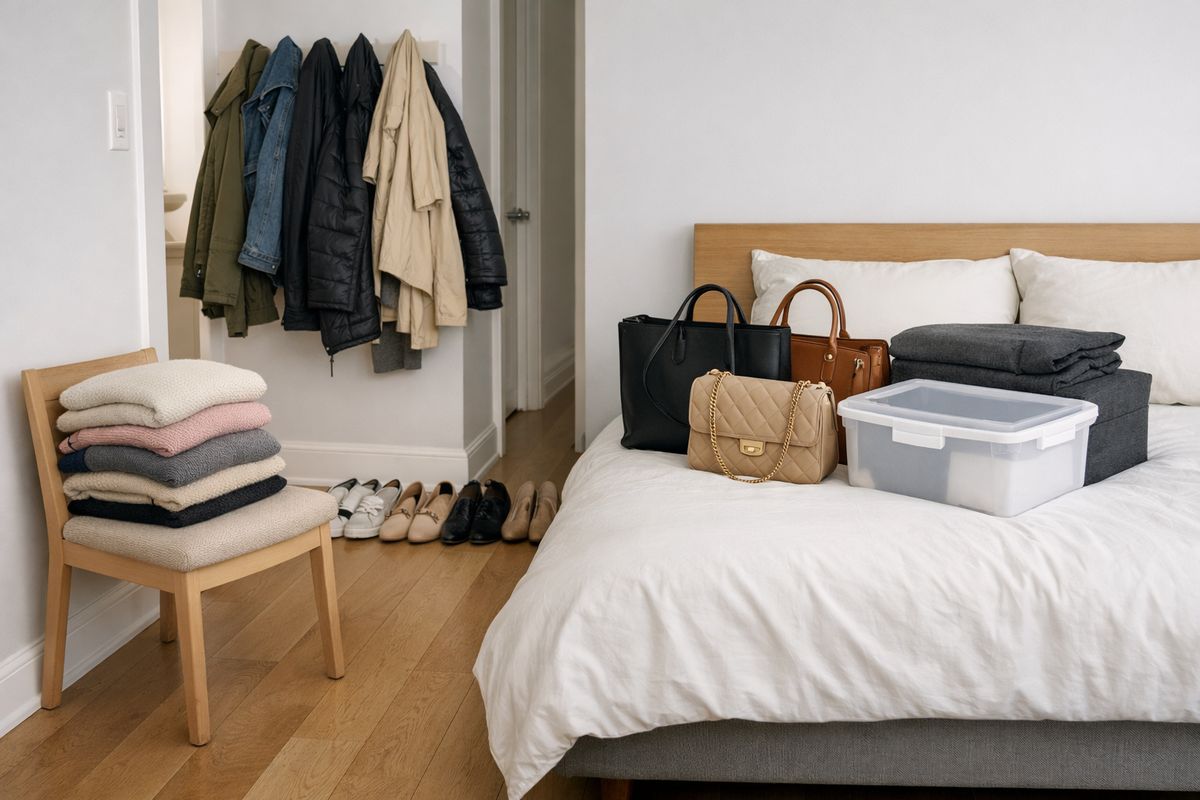
Once your closet starts pushing its contents into other rooms, that is a major red flag. Shoes in the hallway. Folded sweaters in a dresser across the room. Handbags in the guest room. Coats on hooks because the bedroom closet cannot handle them. That spillover is not random. It is your home trying to compensate for a closet that stopped functioning as the storage hub it should be.
This is one of the most common signs because it happens gradually. One under-bed bin turns into three. A hall closet takes in overflow. A laundry room shelf starts holding things that really belong in the bedroom. Before long, one weak closet creates clutter in half the house.
Spillover areas to call out
The bedroom chair is an obvious one. So is the space under the bed, where off-season or overflow items often end up in bins that are hard to access and easy to ignore. Hall closets become catch-alls for shoes, bags, or extra jackets. Guest rooms quietly become backup closets. Laundry room shelves absorb items that should have a better home closer to where you actually use them.
These workarounds are understandable, but they create distance between items and routines. If sweaters live in one place, shoes in another, and bags in a third, getting dressed starts to feel like a scavenger hunt.
When whole-home organization is really a closet issue
Sometimes a clutter problem that looks whole-house is really one closet failing upstream. If your primary closet underperforms, pressure spills onto dressers, guest rooms, hallway storage, and even bathroom cabinets. That is why a closet upgrade can improve more than just the closet itself.
This is also why it helps to think beyond individual bins and ask which storage hub in your home is under the most pressure. In many homes, the answer is obvious. Once you fix that hub, everything else starts to settle down.
If you’re comparing stopgap products with permanent solutions, it helps to look at what tends to last longer in real-life use, especially when the clutter has already spread beyond one room.
Sign #6: You Need Storage for Specific Things a Basic Closet Was Never Built For
A basic closet assumes a very simple life: a few hanging clothes, maybe a shelf, maybe some floor space for shoes. Real life is not that neat.
You may need room for long dresses, folded denim, boots, jewelry, handbags, watches, workout gear, luggage, a hamper, extra bedding, or even a small vanity spot where you can actually get ready without balancing things on a dresser. Once your belongings span different shapes, sizes, and routines, a generic closet breaks down fast.
That is not a sign you are high-maintenance. It is a sign your storage categories are more varied than the original closet design allowed for.
Specialized features worth knowing
Some specialty features are more useful than they sound. Tilt-out hampers hide laundry without eating floor space. Jewelry drawers keep small items visible and protected. Belt and tie racks stop accessories from vanishing into random hooks and hangers. Shoe walls or angled shelves make pairs easier to see and grab. Pull-out baskets help for workout clothes, scarves, or casual folded items.
In larger walk-ins, islands can add drawers and surface space, though only if the room can handle them without crowding movement. Hidden laundry storage is another strong upgrade because it removes one of the biggest sources of visual clutter with almost no daily effort from you.
Specialty pieces do add cost, but they also solve real categories that a basic rod-and-shelf setup never addressed. If you’ve started exploring storage options that actually match how you live, you’ve already felt that difference in theory. The goal is to make it work in your exact space.
Boutique-looking vs. actually useful
A pretty closet is nice. A useful closet is better.
That’s worth saying because the market loves the boutique look. A lot of homeowners do want a more polished closet, and 44% say they like that high-end boutique feel. But the real value is not the pretty drawer fronts or the fancy hardware. It is having a place for the things you touch every day.
If the space looks beautiful but still leaves your handbags piled up, your hamper exposed, and your everyday shoes buried, it has missed the point. Attractive details should support function, not distract from it.
Sign #7: You’re Ready for a Real Fix, Not Another Organizer Experiment
This is the tipping point sign, and honestly, it is often the most honest one. You have tried the inserts, the bins, the slim hangers, the shelf risers, the shoe cubbies, the baskets, the labels, and the seasonal resets. Some helped for a while. None fixed the root issue.
At some point, you stop wanting another workaround and start wanting the problem solved.
That shift matters because it changes how you think about the investment. Instead of asking whether a custom closet is indulgent, you start asking how much time, effort, and frustration you want to keep spending on a problem that keeps returning.
How to tell you’ve reached the tipping point
You reorganize the same closet over and over. You buy duplicate items because you cannot find what you already own. You avoid putting laundry away because there is nowhere obvious to put it. You feel annoyed every time you open the door, or a little embarrassed when someone sees the mess.
There is also the quieter sign: you’ve stopped expecting the closet to work. You’ve adapted your habits around its failures. That adaptation can look practical on the surface, but it often means your home is serving the closet instead of the closet serving your home.
The strongest reason to invest
If your closet steals time and creates stress every week, a better system is not indulgent. It is functional home improvement.
That direct claim is worth standing on. Storage is part of how a home works. A closet that cannot support your routine is not a minor cosmetic issue. It is a daily-use problem, just like poor kitchen storage or a bathroom with nowhere to put towels.
That is why so many homeowners eventually move past the experiment stage and look into a more permanent custom solution. Not because they want luxury for its own sake, but because they want mornings, laundry, and daily life to run better.
When You May Not Need a Fully Custom Closet
Balance matters here. You do not automatically need a fully custom build just because your current closet is annoying. Sometimes a lower-cost option is enough, especially if the space has decent bones and the problem is more about components than structure.
The real question is whether a simpler fix will hold, or whether you’ll be back in the same spot six months from now.
A modular or semi-custom system may be enough if…
A modular or semi-custom system can work very well in a standard-size reach-in with clean dimensions and no major layout challenges. If you plan to move in a few years, have a smaller wardrobe, or simply need better shelves and hanging zones instead of a full redesign, this can be the smart call.
It also makes sense when your categories are pretty straightforward. Maybe you mostly need double hanging, a few shelves, and one drawer stack. If the space is rectangular, the walls are uncomplicated, and you don’t need built-in specialty storage, modular can give you a lot of the benefit for much less money.
Prefab systems can cost significantly less than custom, sometimes around 60% less, which is no small thing when budget is still taking shape.
A simple refresh may be enough if…
Sometimes the closet itself is not terrible. It is just tired, dim, and badly managed. In that case, a refresh can buy real time. Matching hangers can immediately reduce bulk. Shelf dividers can stop toppling stacks. Better lighting can make hidden items visible. One or two targeted accessories, like a shoe rack or pull-out hamper, can address the biggest pain points without a full overhaul.
Editing can help too, especially if your closet is overloaded with items you genuinely do not wear or need. A smaller reset is worth trying when your categories already fit the space and your frustration is moderate rather than constant.
Signs a basic fix will not hold
Some closets have underlying structural issues that simple upgrades cannot solve well. Sloped ceilings, odd dimensions, short walls, deep corners, awkward doors, shared storage pressure, and severe overflow all point toward a more tailored plan.
The same goes for closets with major dead space. If standard kits leave big unusable gaps or force bad compromises, a basic fix may only delay the real project. You’ll spend money and effort, but the layout problem will still be there.
That is usually the line: if the issue is component-level, a refresh may help. If the issue is layout-level, you need more than accessories.
What You Gain With a Custom Closet Beyond “More Storage”
The obvious benefit is more usable storage. But that undersells the real payoff.
A custom closet can make daily routines easier, reduce visible clutter throughout the bedroom, and use your home’s square footage better. It can also make the space feel calmer, which sounds soft until you’ve lived with a closet that feels chaotic every day.
Better function day to day
The most immediate gain is functional flow. Laundry gets put away faster. Mornings move more smoothly. Items stop piling up because each category has a clear home. You spend less time digging and more time moving through your routine without friction.
Predictability matters here. Once the closet is designed around your real habits, organization becomes easier to maintain because the setup supports it. You are no longer relying on constant effort to keep a bad system from collapsing.
Better use of your home’s footprint
A smarter closet can relieve pressure on the rest of the house. That may mean reclaiming part of a dresser, freeing a guest room from overflow, or getting coats, shoes, and bags out of hallway storage that was never meant for them.
In that sense, a closet project is not only about one room. It can improve how several connected spaces function. That broader benefit is one reason custom storage keeps growing as a renovation category, especially in residential homes where better organization directly improves day-to-day life.
Better visual calm
There is a visual side to this, and it matters. Finishes, hardware, and lighting can absolutely make a closet feel more polished. But the bigger aesthetic win is simpler than that: everything has a place, and the place makes sense.
That sense of order creates calm. Closed storage can hide categories you do not want to see. Open storage can make favorite items easier to track and use. Either way, the room starts feeling less crowded, even before you remove a single thing.
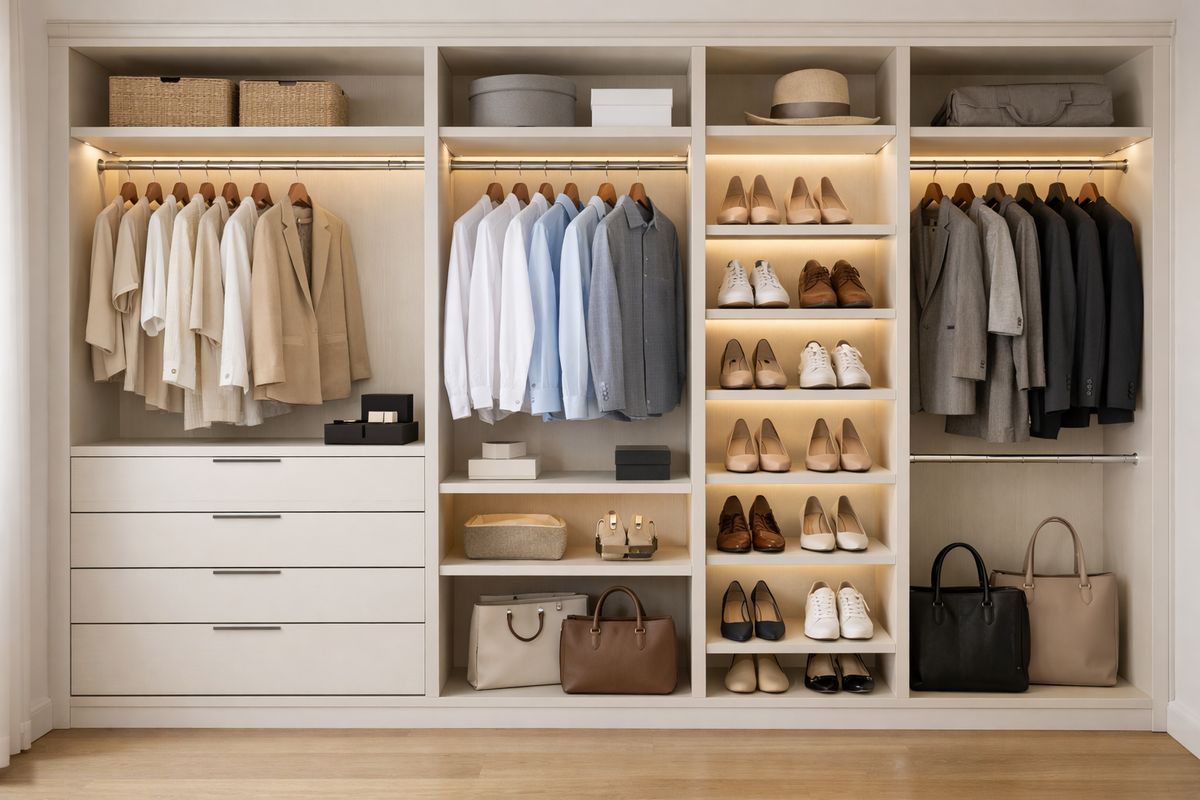
How Much Custom Closet Do You Actually Need?
Not every closet needs the showroom treatment. The smart move is to right-size the solution.
That means matching the level of customization to the actual problem. A compact reach-in may need only better zoning and vertical use. A walk-in may benefit from more elaborate planning because the extra space creates more choices. A shared closet may need fairness and access more than anything else.
Reach-in closet solutions
Reach-ins often benefit the most from precise planning because every inch matters. Double-hang sections, drawers, shoe shelves, upper cabinets, and slim pull-outs can transform a basic reach-in without making it feel crowded.
This is also where customization earns trust quickly. Small closets cannot afford wasted inches. If the current setup leaves floor space cluttered and upper space empty, a tailored layout can make the closet feel much larger without changing its footprint.
Walk-in closet solutions
Walk-ins offer more flexibility, but more space does not automatically mean better function. In fact, a poorly planned walk-in can waste a surprising amount of room.
A walk-in may support islands, seating, mirrors, accessory zones, and a more boutique-style layout, but function should still lead. The best walk-ins make circulation easy, put everyday items within reach, and use perimeter walls intelligently before adding decorative extras.
Shared closet solutions
Shared closets need clarity. Different hanging heights, separate drawers, split zones, and fair access to the easiest-to-reach sections matter more than perfect symmetry. If one side gets all the prime space while the other side gets awkward leftovers, frustration shows up fast.
This is especially true when storage styles differ. One person may want open shelving and visible shoes. The other may want drawers and concealed storage. Good shared design allows both without turning the space into a compromise that satisfies nobody.
If that dynamic sounds familiar, it helps to look at split-zone ideas that make shared storage feel fair before committing to a layout.
What a Custom Closet Costs and What Drives the Price
Cost is often the biggest unanswered question, and for good reason. Custom closets can range from manageable to very expensive depending on the size of the closet, the materials, and the features you choose.
The good news is that most projects land far below the luxury-showroom examples that tend to dominate social media.
Typical cost ranges
Most custom closet installs cost somewhere between a little over $1,000 and a few thousand dollars, with Angi’s average around $2,132. Per-square-foot estimates often fall in the $30 to $50 range for many standard projects, though complexity can change that quickly.
Reach-ins generally cost less than walk-ins. A small reach-in might come in around $1,200, while a medium walk-in often lands closer to $2,500, and larger primary walk-ins can climb from there. Industry data also suggests that 81.3% of closet projects in 2025 cost between $1,000 and $15,000, which tells you most homeowners are shopping in a broad but practical range, not at the extreme high end.
High-end walk-ins can absolutely exceed $50,000, but that is not the default. That is the far end of the market.
What adds cost
The biggest drivers are usually closet size, material choice, number of drawers, finish level, hardware, lighting, specialty accessories, demolition, trim work, and installation labor. Awkward room conditions add cost too, especially if your space has unusual dimensions or needs careful fitting around obstacles.
Materials matter. Laminate and MDF usually keep costs more approachable and install faster. Plywood, cedar, and more premium finishes cost more. Drawers raise the number quickly because they require more materials and labor than open shelves. Lighting, glass accents, and specialty pull-outs can also push the project upward fast.
Installation labor alone often runs from several hundred dollars into the low thousands depending on the job.
Where to save without regretting it
If budget is tight, prioritize layout first. That means getting the hanging zones, shelf count, drawer placement, and overall flow right before spending on decorative upgrades. Adjustable shelves are another smart place to spend because they preserve flexibility as your needs change.
You can often save by choosing simpler finishes, standard hardware, fewer specialty inserts, and laminate or MDF over more premium wood choices. In other words, pay for what fixes your daily problem. Go simpler on the flourishes if needed.
If you want a deeper breakdown of where the money goes, it helps to review what drives installation pricing before comparing quotes.
Questions to Ask Before You Call a Closet Company
A consultation goes better when you already understand your own habits. The goal is not to show up with a perfect plan. It is to show up knowing what is not working and what absolutely needs to change.
That prep can save time, reduce overwhelm, and help you avoid paying for features that look good but do not solve your actual problems.
Questions about your own habits
Start with the basics. What do you hang, and what do you fold? What categories always end up on the floor? What do you reach for every day, and what can live higher up? What needs to be hidden because it gets messy fast? What do you want easier to see?
Also think about pain points, not just inventory. Are shoes the main issue? Is it laundry? Are bags piled on one shelf? Do you need space for long dresses, tall boots, or travel gear? Your problem spots tell the story faster than a generic wish list.
Questions for a designer or installer
Ask about timeline, measurements, materials, warranty, lead times, and installation process. Ask whether the system is adjustable if your needs change later. Ask what happens if your walls are not perfectly square or the floor is uneven. Ask whether lighting or electrical work is included or separate.
It also helps to ask how the layout gets translated from design to install. Precision matters here. A closet can look good in a rendering and still miss practical details if the planning is shallow. That is one reason many homeowners spend time figuring out what to look for in a closet company before making calls.
Photos and measurements to gather first
Before any consultation, take full-wall photos of the closet from several angles. Get rough dimensions for width, depth, and height, even if a professional will remeasure later. Note door swings, outlets, baseboards, attic access panels, windows, and any odd corners.
Then do a quick inventory. Count hanging clothes in broad categories. Estimate shoes, bags, folded stacks, bulky sweaters, linens, and anything oversized. You do not need spreadsheet-level precision. You just need a realistic picture of what the closet must hold.
Smart Features, Materials, and Design Trends Worth Considering
Trends are only useful when they make your closet work better or hold up better over time. The smart way to think about features is not “What’s popular?” but “What will actually improve daily use?”
Some popular features truly do earn their popularity.
Lighting, visibility, and easy-access upgrades
Integrated LED lighting is one of the best examples. It sounds like a luxury until you use a dim closet before sunrise, then realize better light makes every shelf more usable. Pull-out mirrors can help in tighter spaces. Glass-front drawers improve visibility for accessories or folded pieces you want to see without opening every drawer. Soft-close hardware is nice, but more importantly, it tends to make drawers and doors feel better over years of repeated use.
Easy-access upgrades matter most when they remove repeated friction. If you touch it daily, smoother access pays you back daily.
Sustainable and low-maintenance material choices
Material choices have started shifting toward cleaner finishes and lower-maintenance surfaces. Many homeowners prefer low-VOC finishes, engineered wood options, or recycled-content materials that balance durability with a lighter environmental footprint. Research also shows a strong preference for sustainable wood materials and growing use of eco-friendly options across the industry.
Practicality still matters most. Choose surfaces that wipe clean easily, resist wear, and hold up to frequent use. A closet should not become another surface you have to baby.
Open vs. closed storage
Open storage is great for visibility and quick access. It works well for shoes, handbags, folded denim, and categories you use often enough to keep tidy. Closed storage hides visual clutter, reduces dust on certain items, and creates a calmer look.
Neither is universally better. Closed closets account for more demand overall because concealment is appealing, but open shelving remains popular because it makes daily access easier. Your habits should decide. If you like everything visible and actually maintain it, open can work beautifully. If visual clutter stresses you out, lean more closed.
Common Misconceptions About Custom Closets
A few common assumptions stop people from exploring the option, even when the need is real. Most of them come from equating “custom” with “extravagant.”
That is not the full picture.
“Custom closets are only for huge walk-ins”
Not true. Small reach-ins often benefit the most because every inch matters more. A large walk-in has room for mistakes. A tight bedroom closet does not.
When space is limited, exact shelf spacing, the right hanging mix, and smart use of vertical height make an outsized difference. In plenty of homes, the humble reach-in is the closet that most deserves better planning.
“You need a massive budget”
Also not true. There is a wide range, from semi-custom and modular systems to fully built luxury installs. The right solution depends on the problem you need to solve.
Budget matters, of course. High installation and material costs are real barriers for some households. But that does not mean your only choices are “cheap organizer” or “dream walk-in.” There is a lot of middle ground, and for many homeowners that middle ground is enough.
“More storage will just let clutter grow”
A better system does not automatically make anyone tidier. But it does remove a lot of the friction that causes clutter to build in the first place.
When categories have clear homes, access is easier, and visibility improves, maintaining order takes less effort. That does not create discipline from nowhere. It does make discipline less exhausting.
FAQs About Whether It’s Time for a Custom Closet
Is a custom closet worth it for a reach-in?
Yes, often more than for a larger closet. Reach-ins have less room to waste, so better planning pays off quickly. Double hanging, drawers, better shelving, and improved use of height can make a small closet feel far more capable.
Should you do custom closets before selling a home?
Sometimes, yes. If the existing closet clearly underperforms, better storage can improve day-to-day use now and make the home feel more functional later. Closet upgrades are not always the top resale project, but organized storage tends to be noticed and appreciated.
Can you add custom features in phases?
Yes. Many closets are upgraded in stages. You can start with the core layout and structural pieces, then add drawers, lighting, specialty racks, or accessories later as budget allows. That phased approach works especially well when you already know the layout is the real problem.
How long does the process usually take?
The timeline depends on the company, the complexity of the design, and fabrication lead times. A straightforward project may move from consultation to installation in a few weeks, while more complex builds can take longer. Installation itself is often fairly quick once the design and materials are ready.
How do you know if modular is enough or if you need full custom?
If your closet is a standard shape, your needs are simple, and the main issue is missing components, modular may be enough. If the closet has awkward dimensions, major dead space, shared-use pressure, or specialty storage needs, full custom is more likely to solve the problem cleanly.
Frequently Asked Questions
How do you know if you need a custom closet or just better organizers?
A good rule is this: if organizers help for a few weeks but the same problems keep coming back, the layout is probably the issue. Better organizers help when the bones are fine. Custom helps when the bones are fighting your routine.
Is a custom closet only worth it in a primary bedroom?
No. Reach-ins, kids’ closets, hall closets, and guest room closets can all benefit if the current setup wastes space or creates daily friction. The best place to start is usually the closet causing the most repeat stress.
Do custom closets really add more space?
They do not add square footage, but they often add a lot more usable storage. Better vertical planning, double hanging, drawers, and smarter shelf placement can dramatically increase what your closet holds and how easy it is to use.
What if your budget is not ready for a full project yet?
Start by identifying the layout issues that matter most. If a full project has to wait, use that information to avoid spending more on random fixes that won’t last. Then prioritize the pieces that would change daily life the most once you are ready.
Are custom closets too permanent if your needs change later?
Not necessarily. Many systems include adjustable shelves, flexible components, and layouts that can evolve over time. The smartest designs plan for change instead of locking you into one exact setup forever.
A Simple This-Week Test Before You Decide
Try one thing this week: empty one problem zone in your closet, just one shelf or one rod. Then put everything from that zone into categories and notice what has no real home, what is hard to reach, and how many different types of items are fighting for the same space.
That quick audit tells the truth fast. If the issue is a few sloppy habits, you’ll see it. If the issue is the closet itself, you’ll see that too, and you’ll finally know whether you need a minor reset or a real fix.