


If you’re stuck in the closet organizers vs custom closet debate, here’s the short answer: for most long-term homeowners, custom works better. Organizers can tidy the mess for a while, but if your closet has been fighting you for years, the real problem is usually the layout, not a lack of bins.
Quick Overview of Closet Organizers vs Custom Closet
Closet organizers and custom closets both promise the same thing: less mess, less stress, and a smoother start to the day. But they solve different problems.
Closet organizers are usually off-the-shelf products or modular kits. You buy a few pieces, fit them into the space, and hope they create enough structure to keep things under control. A custom closet starts from the opposite direction. Instead of asking how to fit products into your closet, it asks how to shape the closet around your clothes, your routine, and the exact dimensions of the room.
That difference matters more than it sounds. One option rearranges what you already have. The other changes how the space actually works.
What Each Option Actually Is
Shopping gets confusing fast because stores, installers, and manufacturers blur the terms. “Organizer,” “system,” and “custom” get tossed around like they mean the same thing. They don’t.
Closet organizers
Closet organizers cover a wide range: hanging shelves, bins, drawer towers, shoe racks, shelf dividers, under-shelf baskets, and modular kits with adjustable parts. Some are simple add-ons. Some are more ambitious and give you rods, shelves, and drawers in one package.
The common thread is that organizers are usually built in standard sizes. Even modular versions give you flexibility within a set menu of parts. That makes them useful, especially if your closet is mostly fine and just needs better sorting. If your main problem is sweaters sliding off a shelf or shoes taking over the floor, organizers can help quickly.
Custom closet
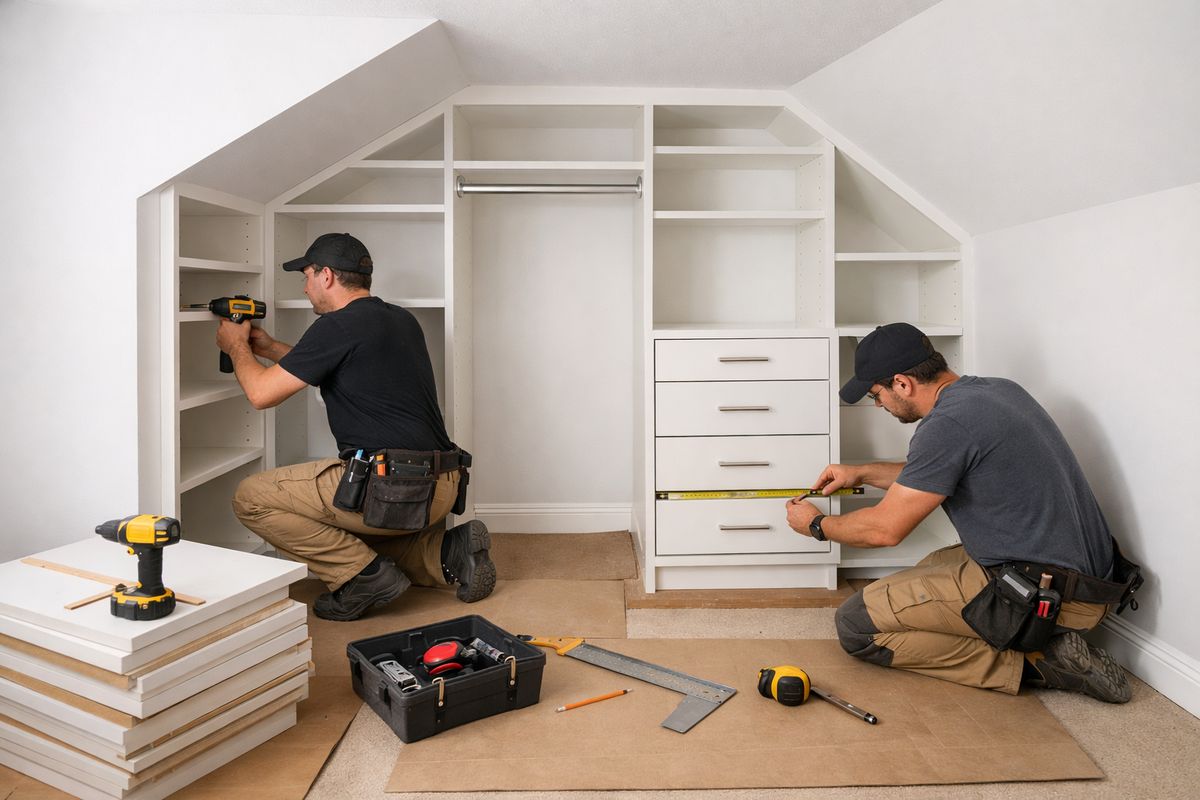
A custom closet is built for your exact space and the way you actually live. It usually involves measuring, design planning, material choices, and permanent installation. Good systems are made to fit odd widths, strange ceiling lines, corner returns, vents, and door swings instead of forcing you to work around them.
That’s why a true built-for-your-space system feels different from a retail kit. It isn’t just more storage. It’s storage arranged on purpose.
Fit and Use of Space
This is where the comparison usually ends up being pretty clear. Custom closets almost always win on space efficiency.
Standard organizers can improve a closet, but they rarely use every inch well. Custom closets are designed to do exactly that. If your closet is awkward, crowded, shallow, extra tall, or shared, that gap gets obvious fast.
Where organizers leave dead space
Dead space is the hidden reason many “organized” closets still feel jammed. You get a drawer tower that leaves a six-inch gap on one side. You add shelves that stop well below the ceiling. You hang a rod and end up with a weird empty pocket underneath that’s too short for anything useful.
That wasted space adds up. Your closet can look fuller while holding the same amount, or sometimes even less, because the products don’t match the room.
Where custom closets solve the layout problem
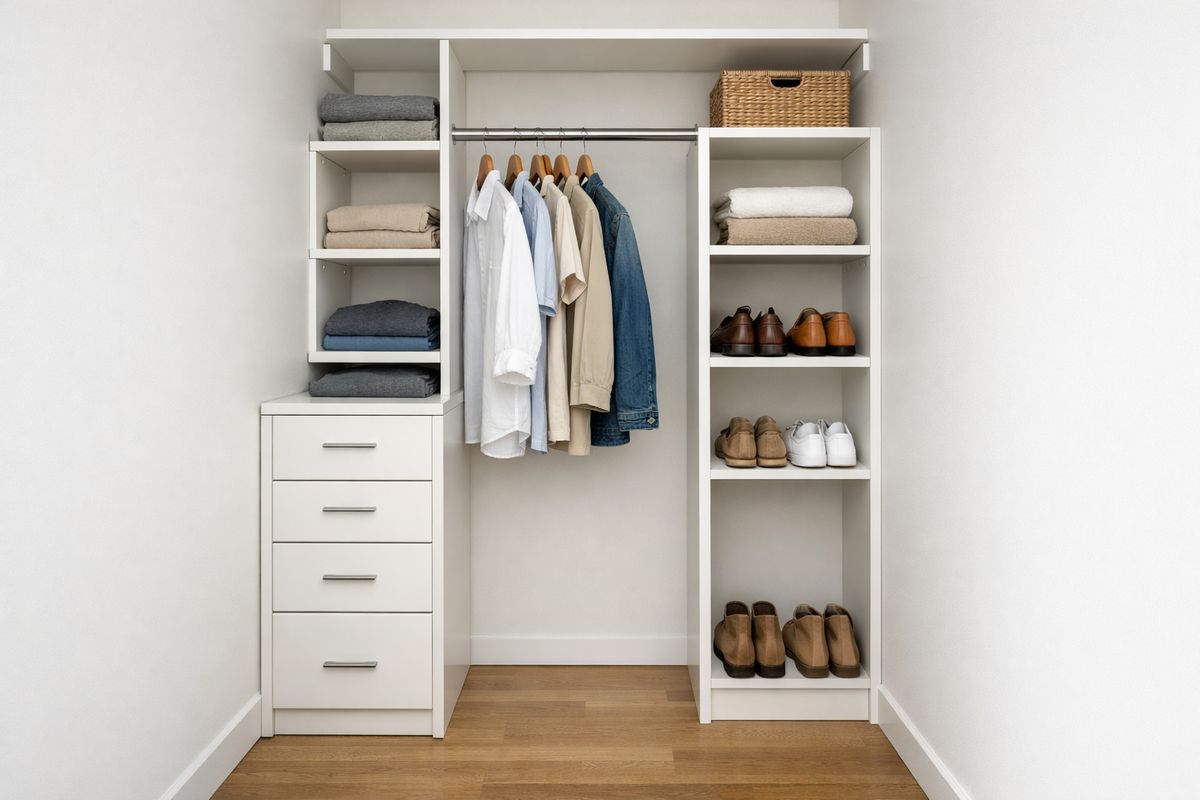
Custom closets fix the layout first. Short-hang sections can sit above drawers. Long dresses can get one dedicated drop zone instead of stealing a full wall. Upper shelves can run to the ceiling. Corners can hold usable shelving instead of turning into black holes.
You notice the difference on ordinary mornings. At 7:15 a.m., when you reach for a work shirt and don’t knock over a stack of jeans or shove hangers aside to get it, that’s not luck. That’s a better layout.
If you’ve been wondering whether your space has crossed from annoying to unworkable, this guide on signs the patchwork fixes are done can help make that call.
Day-to-Day Functionality
A closet should make life easier after the first weekend of setup. That’s the real test.
How organizers help quickly
Organizers are great at giving categories a home fast. Shoes go here. Bags go there. Sweaters stop toppling onto the floor. If your bedroom chair has become a backup closet, a few organizers can absolutely help clear that overflow.
For simple sorting problems, that quick win matters. You can install something on Saturday and feel relief by Sunday.
The catch with organizers over time
The catch is that organizers often create layers of storage instead of a true system. You add bins because shelves are messy. Then shelf dividers because the bins are awkward. Then hanging pockets because the drawers don’t hold enough. Before long, your closet feels like a stack of workarounds.
It’s like adding more utensils drawers to a kitchen with bad cabinets. You’re storing more things, but the room still fights you.
Why custom often stays organized longer
Custom closets tend to stay organized because every zone has a reason to exist. Drawer depth matches folded clothes. Hanging sections match clothing length. Shelves are spaced for shoes, bags, or bins only where bins actually make sense.
That lowers friction. Laundry is easier to put away because there’s a clear place for it. Shared spaces stay calmer because each section has boundaries. If you’re dealing with two wardrobes in one room, these ways to divide closet space fairly show exactly why layout matters so much more than extra containers.
Installation, Time, and Disruption
Speed is the strongest argument for organizers. Efficiency is the strongest argument for custom.
DIY organizer setup
Most organizers can be installed in an afternoon or over a weekend with basic tools. That’s appealing for a reason. No consultations, no waiting for parts, no install appointment on your calendar for three weeks.
If you want a quick reset, organizers are the easiest path to visible progress.
Custom closet process
A custom closet usually involves consultation, measuring, design, ordering, and installation. That sounds slower because it is slower. But it often saves time in another way: you skip the cycle of buying something close enough, returning half of it, drilling new holes, and still ending up with a closet that feels off.
That longer upfront process is part of why so many projects happen inside the broader remodeling market, where homeowners are already investing in spaces that function better, not just look nicer.
Flexibility and Future Changes
This is the section where organizers get a real win.
Why organizers are easier to swap or move
If you rent, expect to move, or just aren’t ready to commit, organizers make more sense. Modular systems can be adjusted, disassembled, and reused somewhere else. If your needs are still changing, flexibility matters more than perfection.
That middle ground is growing, too. More brands now offer modular kits under $1,000, aimed at shoppers who want a step up from basic wire shelving without jumping straight to built-ins.
Why custom works best in a settled home
Custom makes the most sense when your home is settled and your pain points are not temporary. If you’ve lived with the same bad closet for five or ten years, that’s not a phase. That’s a design problem that has earned a real fix.
A lot of homeowners land here after trying every “temporary” solution already. By that point, permanence becomes the benefit, not the drawback. For a deeper look at how that kind of setup works, this overview of storage built around your routine is worth reading.
Durability and Build Quality
Not all organizers are flimsy, but custom systems usually age better under daily use.
Organizer materials and wear
Lower-cost organizers often use wire, fabric, thin laminate, plastic connectors, or lighter hardware. Those materials are fine for light duty. In a busy primary closet, though, sagging shelves, wobble, and loose fittings show up sooner than you’d like.
Better modular kits hold up better, of course. Still, the category is broad, and quality varies a lot.
Custom closet construction
Custom closets are usually built and anchored more like cabinetry. Stronger panels, smoother drawer slides, better hardware, and fixed installation make a big difference over time. According to custom closet market data, these systems are designed around exact dimensions and often include cabinetry-style features like drawers, lighting, and fitted shelving.
That doesn’t just improve looks. It changes how the system feels every single day.
Look and Feel
Storage is functional, but it’s also emotional. You feel the difference the second you open the door.
Organizers and the “improved but still busy” look
Organizers can absolutely make a closet neater. But the space often still reads as assembled rather than designed. Visible bins, mixed finishes, exposed wire, stacked accessories, and products from three different stores tend to create an “improved but still busy” effect.
That may be perfectly fine in a hall closet, kids’ closet, or guest room. In a primary closet you use every day, it can still feel like visual noise.
Custom and the built-in finish
Custom closets feel calmer because everything matches and fits. Shelves line up. Drawers sit flush. Finishes are consistent. Nothing looks wedged in after the fact.
That clean, built-in look matters more than people admit. In one survey, 80% said an organized closet changes the mood every time it’s used. That sounds dramatic until you picture opening the closet door before coffee and not seeing chaos.
Pricing and Long-Term Value
Here’s where organizers make the strongest practical case. They cost less to start. No question.
Still, cheaper upfront is not always cheaper overall.
What closet organizers usually cost
Simple organizers can cost very little. A few bins, a hanging shelf, and some dividers may run less than a dinner out. Modular systems cost more, usually from a few hundred dollars up into the low four figures depending on size and finish.
The problem is that the total often creeps. Baskets, matching bins, drawer inserts, hooks, shoe shelves, and replacement parts add up fast. So do mistakes.
What a custom closet usually costs
Custom closets are a bigger investment. Premium systems commonly land between $2,500 to $10,000 per unit, depending on size, materials, drawers, accessories, and installation.
That’s a real number, and for many households it’s the deciding factor. If you want a clearer breakdown of what drives those prices, this guide to where the money actually goes helps.
For homeowners ready to price a built-in solution directly, custom closet options here show what a full-service approach usually includes.
Cost over time
If you’ve spent years buying one more organizer every few months, you already know how the drip works. Twenty dollars here, eighty there, then a bigger kit, then a replacement because the first one didn’t last.
That’s why the cheapest fix is not always the least expensive path. A one-time investment can cost more upfront and still waste less money.
Home Value, Resale, and Lifestyle Payoff
A better closet changes daily life first. Any resale benefit comes after that.
Organizer value
Organizers mostly deliver personal convenience. They help you function better, and that can be enough. If your goal is quick relief without a major spend, they can be absolutely worth it.
But removable products rarely change how finished a home feels.
Custom closet value
Custom closets can make a home feel more upgraded and more complete. That matters in a market where functional improvements keep drawing spending, with homeowner remodeling spending projected to stay high into 2026.
The lifestyle payoff is usually bigger than resale math, though. An uncluttered, fitted closet lowers daily friction in a way that keeps paying you back.
Best Use Cases: When Closet Organizers Work Better
Organizers are not the wrong choice. They’re just the wrong choice for some problems.
Best for renters and short-term homes
If you may move soon or can’t alter the space permanently, organizers are the smarter option. You get better storage without sinking money into a room you may leave behind. That logic is especially strong in rentals, where better closet space is such a priority that 42% of renters say they’d pay extra for it.
Best for small fixes on a tight budget
If the closet layout is basically fine and your real problem is containment, organizers can solve it. Maybe shoes need structure, maybe handbags need a shelf, maybe folded items need a drawer unit. In that kind of closet, the right organizer is a fix, not a delay.
Best Use Cases: When a Custom Closet Works Better
This is where the answer gets blunt.
Best for awkward or overstuffed closets
If your closet has odd corners, low ceilings, bad shelf spacing, swing-door interference, or wasted vertical space, custom is worth it. Off-the-shelf pieces almost always leave too much room unused in tricky spaces.
That’s also true when the closet is simply overstuffed. Better fit creates real capacity.
Best for homeowners ready to stop patching the problem
If you’ve already tried bins, shelf risers, hanging organizers, and baskets, a prettier organizer probably won’t save you. If the closet has never worked, another add-on won’t suddenly turn it into a system.
That’s when custom stops being a luxury and starts being the practical choice. If you want inspiration for what a finished result can look like, these smart ways to rethink the layout are a good next step.
The Verdict: What Actually Works?
For most long-term homeowners, custom closets work better. They fit better, function better, last longer, and solve the real issue, which is usually bad use of space.
Closet organizers win when flexibility, low commitment, or a smaller budget matters most. But for a closet that has been frustrating you every weekday morning for years, custom is usually the answer.
Winner for most long-term homeowners: custom closet
Custom is the stronger choice if you want a lasting fix. You get a system built around your actual wardrobe, your actual room, and your actual habits. Less dead space, less clutter, less daily friction.
That’s what “works” usually means.
Winner for short-term flexibility: closet organizers
Organizers are best when you need a faster, cheaper, more portable solution. They’re useful, practical, and often good enough for temporary homes or minor storage problems.
Just don’t expect them to solve a fundamentally bad closet layout.
Try This Before You Decide
This week, empty enough of your closet to see the structure clearly. Then count the problem areas.
How many are category problems, like shoes with no home or sweaters with no divider? And how many are layout problems, like wasted height, rods in the wrong place, shelves too deep, or corners that can’t be used well?
That one exercise usually tells you the truth fast. If most of the pain comes from layout, stop buying more organizers.
Frequently Asked Questions
Are closet organizers cheaper than a custom closet?
Yes, almost always upfront. Organizers range from inexpensive add-ons to mid-priced modular kits, while custom closets usually start much higher because design, materials, and installation are part of the package.
Do custom closets really hold more?
In most cases, yes. Custom closets use vertical space, awkward corners, and exact dimensions far better than standard-size products, so you usually gain more usable storage without making the closet feel packed.
Are closet organizers good enough for a primary bedroom closet?
Sometimes, but only if the closet layout is already decent. If your main issue is sorting categories, organizers can be enough. If the closet wastes space or feels impossible to maintain, custom usually works better.
Does a custom closet add home value?
It can help a home feel more finished and more functional, which buyers notice. The bigger payoff, though, is everyday livability. You use that benefit long before resale enters the picture.
How do you know when to stop buying organizers?
Stop when each new product solves one small mess but creates another layer of clutter. If you keep adding bins, shelves, and dividers and the closet still feels frustrating, the layout is probably the real problem.
Is a custom closet only for luxury homes?
No. Custom closets can be high-end, but the idea is simply better fit and better function. Plenty of homeowners choose custom because the closet is used hard every day and temporary fixes have already failed.