


If your shared closet feels like a daily argument waiting to happen, the problem usually is not laziness, messiness, or one more failed bin. Couples closet organization works when the setup fits two real wardrobes, two routines, and two very different ways of getting dressed on a Tuesday at 7:12 a.m.
1. Stop Chasing a Perfect 50/50 Split
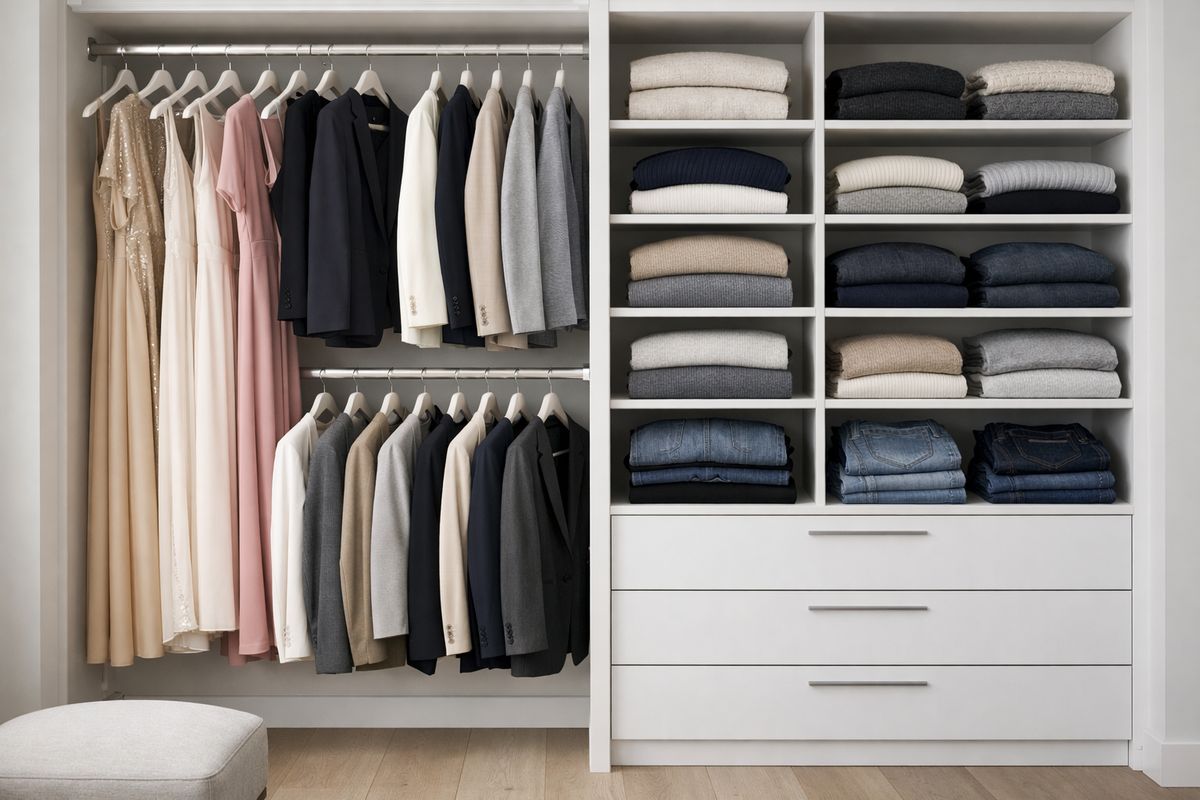
A strict half-and-half split sounds fair, but it often makes a closet harder to use. One side may need twice as much hanging space for workwear, dresses, or jackets, while the other side needs more shelf room for denim, sweaters, or activewear. A better system starts with actual storage needs, not a visual line down the middle.
This is one of the biggest reasons shared closets keep failing. You keep trying to force one layout to serve two people in exactly the same way, even when the wardrobes are nothing alike. The fix is simple: divide the closet by what has to live there and how often it gets used.
What “fair” looks like in a real closet
Fair means counting categories before assigning territory. Look at hanging clothes, folded clothes, shoes, bags, accessories, and laundry. If one side has 30 button-downs and almost no folded items, that side needs rods more than drawers. If the other side has fewer hanging pieces but more sweaters, jeans, and workout clothes, shelves and drawers will work harder than another hanging bar.
That approach usually feels better fast because it removes the weird guilt from the process. You are not rewarding one person for owning more stuff. You are matching the storage to the wardrobe.
Research backs this up. Shared closets tend to work better when you stop assuming 50/50 closet split is the goal and start dividing based on real needs.
When one person clearly has more to store
Here’s the thing: more stuff needs more space. There is no elegant way around that. If one wardrobe is simply larger, you either give it more room or move part of it elsewhere.
That does not mean your bedroom has to feel uneven or tense. It means your closet has to tell the truth. Maybe occasionwear goes to a guest-room wardrobe. Maybe handbags move to a dresser. Maybe one side gets more rod space, but the other gets easier access to drawers and daily shoes. Fairness is about friction, not symmetry.
If you want more examples of layouts that feel balanced without forcing a fake split, take a look at ways to make shared storage feel fair.
2. Declutter Before You Buy One More Bin
Bins are not the answer when the closet is already over capacity. Shelf inserts are not the answer. Another hanging organizer is definitely not the answer.
If your closet feels packed, your first job is not organizing. Your first job is editing. Professional organizers keep saying the same thing for a reason: build a system around too much stuff, and the system collapses almost immediately.
A simple closet edit that doesn’t eat your whole Saturday
Do not pull out every single item unless you enjoy turning your bedroom into a retail stockroom. Instead, work in tight, finishable passes. One rod. One shelf. One drawer. Sort each area into keep, relocate, donate, tailor, and toss.
That small-project approach is more realistic, especially if clutter already feels emotional or exhausting. A less-than-an-hour target keeps the job from turning into another abandoned weekend project.
You will probably find that a lot of what is clogging the closet is not even active wardrobe. That tracks with how most homes function. The biggest organizing push in the market right now is still decluttering service demand, because getting rid of the excess is usually the part that changes everything.
What to pull out first
Start with the easy wins. Dry-cleaning bags. Empty shoe boxes. Broken hangers. Mismatched hangers. Shoes that hurt. Clothes waiting years for tailoring. Formalwear taking up prime eye-level space even though it gets worn twice a year.
Then go after the quiet space thieves: duplicates, “someday” pieces, and out-of-season items. A lot of closets look full because they are storing too many low-value things in the most valuable real estate. One estimate from organizers says 80% of clothes get worn only 20% of the time. That sounds extreme until you start pulling out the pieces you forgot you owned.
3. Create Clear Personal Zones So Nothing Feels Up for Grabs
Shared closets go sideways when every shelf feels negotiable. If nobody knows what belongs where, the whole closet turns into a soft argument. A sweater lands on the wrong shelf, shoes drift into the middle, a bag gets set down “just for now,” and suddenly half the closet feels like public property.
Defined zones fix that. Not because labels are magical, but because boundaries reduce tiny decisions and tiny resentments.
Best zone layouts for reach-in closets
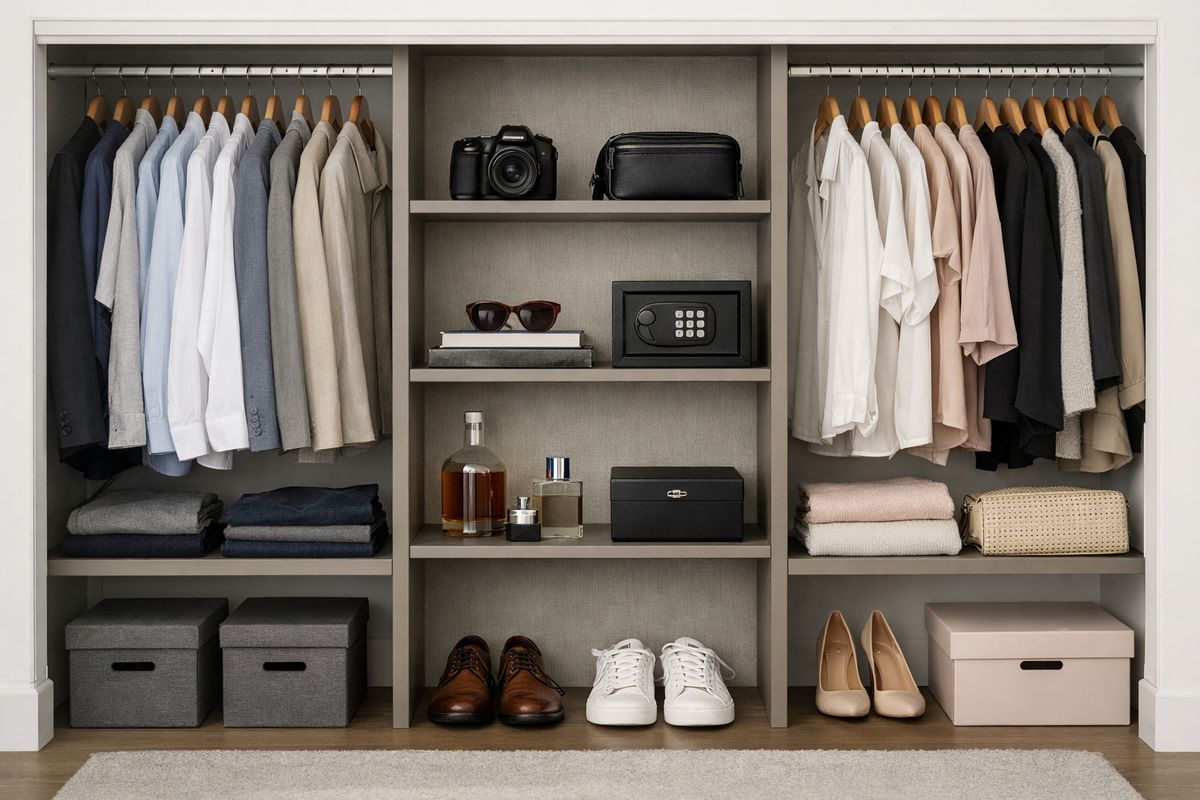
In a reach-in closet, the easiest setup is usually left and right. Each side gets its own rod section, shelf section, and floor zone if possible. If the closet is narrow or odd, use an upper-and-lower split instead. One person gets the top rod and shelf bank, the other gets the lower rod and floor shelf area, adjusted for height and comfort.
The trick is making the split obvious enough that you do not have to think about it. One narrow center shelf that belongs to both of you sounds cooperative, but honestly, it usually becomes a junk shelf.
Best zone layouts for walk-ins
Walk-ins give you more flexibility, but only if you use that flexibility on purpose. The best layouts usually give each person a home base: separate walls, separate towers, or mirrored sections. That way, your daily wardrobe, laundry, accessories, and shoes are mostly handled from one zone instead of overlapping in the center.
If your walk-in still feels chaotic, the issue may be the layout itself, not your habits. That is where storage plans built around your actual routine start to make more sense than generic add-ons.
4. Organize Around Morning Routines, Not Just Categories
A closet can be perfectly sorted and still be annoying. That is the catch.
Most organizing advice stops at categories: shirts here, pants there, shoes below. But couples closet organization gets much easier when you map the closet around what happens in real life. Who gets dressed first. Who reaches for work clothes daily. Which shoes get worn all week. Where the hamper needs to be because that is where clothes actually come off.
Daily-use placement that saves real time
Put weekday workwear at hand level. Put favorite shoes where you can step into them without crouching into a dark corner. Keep the bag, wallet tray, watch, or jewelry you touch every morning within one reach. Store occasional items higher up, lower down, or outside the closet completely.
This sounds obvious, but it is where a lot of closet frustration lives. If your most-used items are hidden behind less-used items, mornings feel harder than they need to.
How to reduce traffic jams
Try separating your highest-traffic zones. Do not store both daily shoe collections in one narrow center strip. Do not force one hamper into the same corner both of you need at the same time. Give in-between clothes, laundry, and next-day outfits their own spots so they are not clogging the getting-dressed zone.
A calmer closet is often just a lower-conflict closet. Fewer crossed paths. Fewer shared choke points. Fewer elbows.
5. Give Each Type of Clothing the Storage It Actually Needs
Not every item belongs on a shelf. Not every item belongs on a rod. And not every closet needs the same ratio of hanging, folding, and drawer storage.
That is why random organizers disappoint so often. They solve for “clothes” in general, when your closet really needs different storage for dresses, denim, sweaters, suits, activewear, handbags, and accessories.
Use more double hanging where it makes sense
Double hanging is one of the fastest ways to gain space, especially in smaller reach-ins. If you wear a lot of shirts, blouses, folded-over pants, skirts, or shorter jackets, two rods can double the usable hanging area in the same footprint.
It works because short garments waste a lot of vertical space when hung on a full-height rod. If your closet has one tall section filled with shirts hanging above empty air, that space is not working hard enough.
Reserve long-hang space for the pieces that truly need it
Long-hang space should be reserved for dresses, coats, long skirts, or anything else that really needs the drop. Most closets use too much long-hang because it feels tidy on paper, but it is a poor trade if only a handful of items need it.
This is where even a basic redesign can change the whole closet. You do not always need a full renovation, but you do need storage that fits your wardrobe mix. If you are weighing prefab pieces against something more tailored, this breakdown of what actually works best helps clarify the trade-offs.
6. Go Vertical Instead of Letting Dead Space Win
Vertical storage just means using the full height of the closet instead of pretending the useful part stops at eye level. In most closets, the top third is wasted or becomes a graveyard of loose bags, old boxes, and mystery piles.
That space can carry more than you think, especially for items you do not need every morning.
Smart ways to use top shelves
Top shelves are best for luggage, keepsakes, off-season clothes, backup bedding, travel gear, and anything else you need access to, just not often. Use bins or containers so the shelf does not turn into a landslide.
The smarter move is to treat that top shelf like long-term parking, not quick access. If you have to pull it down every weekday, it does not belong up there.
Add height without creating a hard-to-reach mess
Matching bins help because the shelf stacks cleanly. Labels help because nobody wants to open three identical boxes looking for a scarf. Shelf risers, cubbies, and narrow stackable containers can add another layer of storage without making the whole closet feel jammed.
Keep limits. One bin for travel gear means one bin, not four. That is how vertical storage stays useful instead of becoming a postponed decision.
7. Standardize the Hangers and Instantly Get Space Back
Mixed hangers waste more room than most people realize. Plastic hangers jut out at different widths. Wooden hangers bulk up the rod. Wire hangers twist clothes into odd shapes and snag delicate fabric. The rod gets crowded faster, and the closet looks busier than it is.
Switching to one slim hanger type is one of the fastest, least dramatic upgrades you can make. The closet looks calmer in an hour, and you usually get real space back.
Which clothes belong on slim hangers
Slim non-slip hangers are great for shirts, blouses, lightweight jackets, and many pants. They keep garments from sliding off and let clothes sit closer together without looking crushed.
This is one of those simple fixes that pays off immediately. It is not glamorous. It just works.
What not to force onto one hanger type
Do not put everything on the same hanger just because matching feels satisfying. Heavy coats, structured jackets, and bulky knits often need sturdier hangers with better shoulder support. Specialty pieces should be stored for the garment, not for the visual aesthetic.
Uniform where it helps, flexible where it matters.
8. Divide Shelves and Drawers So Stacks Stop Collapsing Into Each Other
Shared shelves are like shared counter space. Without boundaries, one pile slowly expands until it takes over everything around it.
Shelf dividers and drawer dividers fix a surprisingly annoying problem: drift. Sweaters lean. Jeans spread. Socks mix. Sleepwear migrates. Small containment keeps categories readable and keeps one person’s stuff from spilling into the other person’s area.
Shelf dividers for sweaters, jeans, and handbags
Shelf dividers act like bookends for folded clothing. They hold stacks upright, which means you can pull one sweater without flattening the whole shelf. They also help handbags stay in one lane instead of slumping into each other.
You do not need perfect folding for this to work. You just need a stop point.
Drawer dividers for smaller shared categories
Drawers are best when you divide them by category instead of treating them like soft storage junk drawers. Socks, undergarments, sleepwear, workout gear, and smaller accessories all do better with sections.
There is a reason people keep buying these tools. Closet systems, hooks, bins, and dividers are already common in American homes, but not universal. One YouGov survey found plenty of room for improvement in how people use drawer-based storage tools, especially in closets that need to work for more than one person.
9. Build a Real Shoe System Instead of a Floor Pile
Shoes can wreck an otherwise decent closet. Once the floor turns into a loose pile, the closet starts feeling permanently unfinished.
A real shoe system does not have to be expensive. It just has to match how often each pair gets worn.
Separate everyday shoes from occasional pairs
Keep current favorites easy to reach. That means the shoes you actually wear during the week, not the heels from the wedding three summers ago or the boots waiting for weather that has not arrived yet. Formal, seasonal, or sentimental pairs can move higher, farther back, under the bed, or into another storage area.
This alone can clear a surprising amount of floor space.
Use the floor on purpose
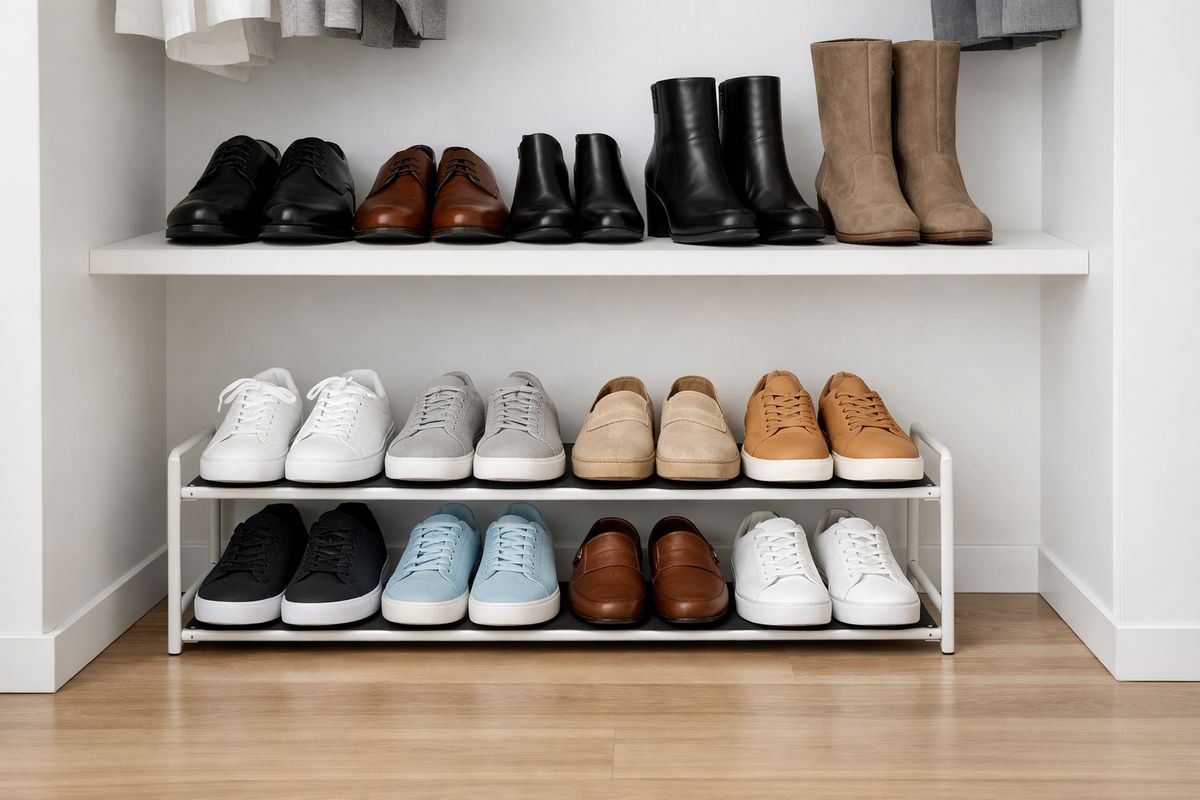
The floor can work for shoes if you give it structure. Low shelves, cubbies, or a simple rack can keep pairs visible and contained. But loose shoes scattered under hanging clothes are a trip hazard and a dirt magnet.
If your closet footprint is tight, floor storage should be shallow, deliberate, and limited to what fits cleanly. Once shoes start double-stacking in front of each other, the system is already failing.
10. Contain Accessories Before They Scatter Across Every Surface
Accessories are small, which is exactly why they create such a big mess. Belts end up over chair backs. Jewelry lands on the dresser. Scarves slide off shelves. Bags get dropped wherever there is an open corner.
If you want the closet to feel finished, accessories need homes too.
Easy accessory storage that doesn’t need a full remodel
Hooks, peg rails, hanging organizers, trays, shallow bins, and drawer inserts can handle most of the problem. Belts and ties do well on dedicated hooks or rails. Jewelry does better in trays or small drawer compartments than in random dishes across the bedroom. Bags can be lined up on shelves or held upright in divided cubbies.
The point is not to create a boutique display. The point is to stop the daily search for one small thing that somehow disappears every morning.
Keep grab-and-go items visible
If you use it often, you should be able to see it. That matters even more if closed bins tend to become black holes in your house. Open trays, shallow drawer sections, clear bins, or front-facing hooks make repeat-use items much easier to keep up with.
Visibility is not clutter if the zone is contained.
11. Use Doors, Walls, and Awkward Corners for Bonus Storage
When the closet footprint cannot grow, the overlooked surfaces have to start pulling their weight. Doors, narrow wall strips, side panels, and odd corners can solve a lot of small but irritating problems.
This is the trick that helps when your closet is truly undersized and every square inch matters.
Over-the-door storage that’s actually worth it
Over-the-door storage is worth using when it holds light, narrow categories: shoes, scarves, belts, hats, or tomorrow’s outfit. It is not great for bulky items that bang around every time the door moves.
Pick one job for the door and stick to it. Once the pockets become a random catch-all, the door turns into visual noise.
Small upgrades that solve annoying little problems
A valet rod gives you a place to hang the next day’s outfit, steam a shirt, or stage dry cleaning. A hook near the entry can hold a robe, bag, or returns that need to go back out. A narrow vertical strip can hold hooks for hats or belts. One awkward corner can become a hamper zone instead of dead air.
These are not dramatic upgrades, but they solve the kind of little recurring problems that make a closet feel aggravating.
12. Give Overflow a Home Outside the Closet
Sometimes the closet is just too small. Not badly organized. Not under-optimized. Too small.
When that is true, forcing every item into the primary closet is the real mistake. A better system accepts reality and creates intentional overflow elsewhere.
Best items to move out first
Move out off-season clothing, occasionwear, handbags you do not use weekly, sentimental pieces, extra bedding, and rarely used outerwear. These items take up a lot of space without earning daily access.
Under-bed drawers work well for soft goods. A dresser can absorb folded categories. A wardrobe cabinet can take on overflow hanging. Even a spare-room rack or cabinet can relieve pressure from the main closet.
Satellite storage without making the bedroom feel messy
The word “overflow” sounds temporary, but it does not have to look temporary. Furniture with drawers, closed cabinets, under-bed containers that slide neatly, or matching storage boxes can make extra storage feel planned instead of apologetic.
If your setup has outgrown quick fixes, this is usually the point where a more tailored solution starts to make sense. Built-around-your-space options can solve the deeper layout problem instead of asking you to keep rearranging the same crowded closet.
13. Add Laundry and “In-Between” Clothing Solutions
A lot of closet mess is not clean clothes or dirty clothes. It is the in-between stuff. The jeans worn once. The sweater you will wear again. The shirt that needs dry cleaning. The jacket waiting for a button repair.
Without a place for those items, they end up on the chair. Then the bench. Then the floor.
Fix the “chair clothes” problem
The chair pile exists because it is doing a real job. It is holding clothes that are not ready for the hamper but not ready to go back into prime storage either. Replace the chair with a better version of that function: one valet hook, one shelf, one basket, or a small hanging section just for re-wear items.
Keep it limited on purpose. Once that zone is full, you have to decide what gets reworn, rehung, or washed.
Make laundry easier for two people
Separate hampers help, especially if your habits are different or you sort laundry differently. Double hampers are even better if you want built-in lights and darks. The main rule is simple: put the hamper where clothes actually come off.
This sounds almost silly, but it matters. If the hamper is tucked into an inconvenient corner, clothes will land somewhere else. That is human nature, not a character flaw.
14. Improve Visibility With Better Lighting and Labels
A dim closet is harder to maintain. You miss what you own. You lose track of what belongs in bins. You stop putting things back carefully because you cannot see the space clearly in the first place.
Better lighting makes a closet feel bigger, cleaner, and easier to use, even before you change a single shelf.
Lighting upgrades that make a big difference fast
Battery puck lights, motion-sensor lights, and simple LED strips can make a major difference without rewiring anything. Put light where shadows collect: under shelves, over rods, and in dark corners where shoes or bags disappear.
This is one of those upgrades that feels minor until you actually flip it on. Then the whole closet suddenly makes more sense.
Labels that help without making the closet feel overdone
Labels do not need to be cute or complicated. Seasonal. Travel. Workout. Bags. Tailoring. Donate. That is enough.
Use them where categories are easy to forget, especially on upper shelves or matching bins. If both of you can tell at a glance what belongs in a container, the closet holds its shape longer.
15. Set a Maintenance Rule You Can Actually Keep
The best closet systems fail when the upkeep plan is fantasy. If your maintenance rule depends on a monthly four-hour reset, it is not a rule. It is a wish.
A working closet needs a rhythm you will actually follow. Short resets. Seasonal edits. Clear boundaries. Shared responsibility.
This part matters more than most people admit. Organizing labor often lands unevenly at home, and that can quietly sour even a nicely designed space. One YouGov poll found only 28% of Americans say organizing is shared about equally in the home. Your closet should not become another example of that.
A 10-minute weekly reset
Ten minutes is enough for a real reset if the system is decent. Rehang strays. Put shoes back. Clear the floor. Empty pockets. Move donations to the bag. Return accessories to their zones. Done.
That weekly touchpoint works better than waiting until everything gets out of hand, which is how many households approach organizing in the first place. The smaller the reset, the more likely it happens.
When it’s time to call in help
If the layout is fundamentally wrong, effort alone will not fix it. That is when professional help can be worth it. A basic prefab closet system can cost about $200 to $2,200 installed, while built-ins and custom solutions cost more but solve deeper space problems. Hiring a professional organizer also has a wide range, with closet-specific work often landing far below a full-home project.
The good news is that closet projects are usually manageable in scope. A small closet reset can take just a few hours, not a week-long overhaul. If you are at the point where every morning starts with irritation, paying for a smarter layout can be money well spent. If you are still deciding what level of solution makes sense, it helps to read through what separates a good closet company from a flashy one.
Frequently Asked Questions
How do you divide a closet fairly for two people?
Divide it by wardrobe type and volume, not by a perfect half-and-half line. If you need more hanging space and less shelving, your zone should reflect that. Fair means each person can store daily clothing comfortably without crowding or guessing.
What is the best couples closet organization idea for a small reach-in closet?
Start with clear personal zones, double hanging for shorter garments, slim matching hangers, and a real shoe system. In a small reach-in, those four changes usually do more than adding random bins.
Should out-of-season clothes stay in the shared closet?
Usually no. Off-season items eat valuable space that your daily wardrobe needs right now. Move those pieces to top shelves, under-bed storage, or another room so the main closet can handle current use.
What if one person has a lot more clothing than the other?
Give more space to the larger wardrobe or move some categories elsewhere. Pretending both wardrobes need the same amount of room usually creates more frustration than simply acknowledging reality and planning around it.
Are custom closets worth it for couples?
They can be, especially if the closet layout is the real problem. Custom or semi-custom systems work well when you need different rod heights, drawer mixes, accessory storage, or better use of awkward space. If you are unsure where the tipping point is, signs your closet has outgrown quick fixes can help you decide.
How often should you reset a shared closet?
A quick weekly reset and a deeper seasonal edit once or twice a year is enough for most households. The key is consistency. Short maintenance beats occasional marathon cleanups every time.
Try one fix this week
Pick the one thing that annoys you most: the shoe pile, the mixed hangers, the chair full of in-between clothes, or the shelf that belongs to nobody. Fix just that one area this week, and notice how much calmer the next Tuesday morning feels.