


If your bedroom chair has turned into a second closet, you’re already paying for bad storage every single morning. Closet installation cost feels like a big unknown, but the real price is usually easier to understand once you break it into the parts that actually fix the problem.
What closet installation cost usually looks like
Most homeowners land somewhere around $1,045 to $3,218 for a custom closet project, with a typical average near $2,132. That said, a lot of real-world jobs stretch across a much wider band. Industry survey data shows 81.3% of projects fall between $1,000 and $15,000, which makes sense once you factor in size, materials, and how custom the design gets.
And yes, luxury walk-ins can blow past that. Far past it. A boutique-style closet with full-height built-ins, specialty drawers, lighting, and island storage can climb beyond $50,000.
Here’s the thing: you are not just paying for shelves. You are paying to remove a daily bottleneck. The rushed 7:20 a.m. moment when shoes are buried, folded stacks slide over, and the one shirt you need is jammed behind three things you never wear, that is the problem the install is meant to fix.
What you’re really paying for in a closet installation
“Installation” sounds like one service, but the catch is that it is usually a bundle. Your total often includes design work, measurements, materials, labor, prep, and whatever upgrades make the system feel finished instead of temporary.
Design and measuring
Before a single shelf goes up, somebody has to figure out what actually fits. That means measuring walls, checking ceiling height, spotting outlets and baseboards, accounting for doors that swing into the space, and deciding how much room should go to hanging clothes, drawers, shelves, or shoes.
This part matters more than people think. A closet can be beautifully built and still be wrong. If your long dresses need vertical space but the layout gives you endless cubbies, you paid for millwork and still kept the chair pile. Planning is where function gets decided.
Design fees may be bundled into the quote or charged separately, and consultations can sometimes run about $100 to $300. If you want a better feel for what a tailored setup actually changes, this guide on why made-for-you storage works differently helps connect the layout decisions to daily use.
Materials and finishes
Materials change the price fast, and not in a subtle way. According to material cost ranges, laminate often runs about $125 to $150 per linear foot, MDF about $140 to $240, plywood about $150 to $500, and cedar about $200 to $500.
Budget materials usually solve the problem for less money. Better materials usually last longer, handle wear better, and look cleaner over time. That is the trade. Laminate and MDF are often easier on the budget. Plywood and cedar cost more, but they can feel sturdier and more furniture-like, especially in a primary bedroom where you see the closet every day.
Finishes quietly add cost too. The more polished the look, the more you tend to pay. Edge details, upgraded drawer fronts, glass accents, custom paint, and hardware swaps can push a quote upward without adding a single inch of storage.
Labor and installation complexity
Labor is not the side note. It is a big part of the bill. Typical labor ranges run from $500 to $2,500, with hourly rates often around $40 to $120 per hour.
That money goes toward real work: cutting panels, leveling components, mounting rails, trimming around baseboards, adjusting drawers so they glide properly, and dealing with the fact that older homes are almost never perfectly square. A closet that looks simple on paper can turn fussy in person if the walls bow, the floor dips, or the opening is tighter than expected.
Prep, demolition, and cleanup
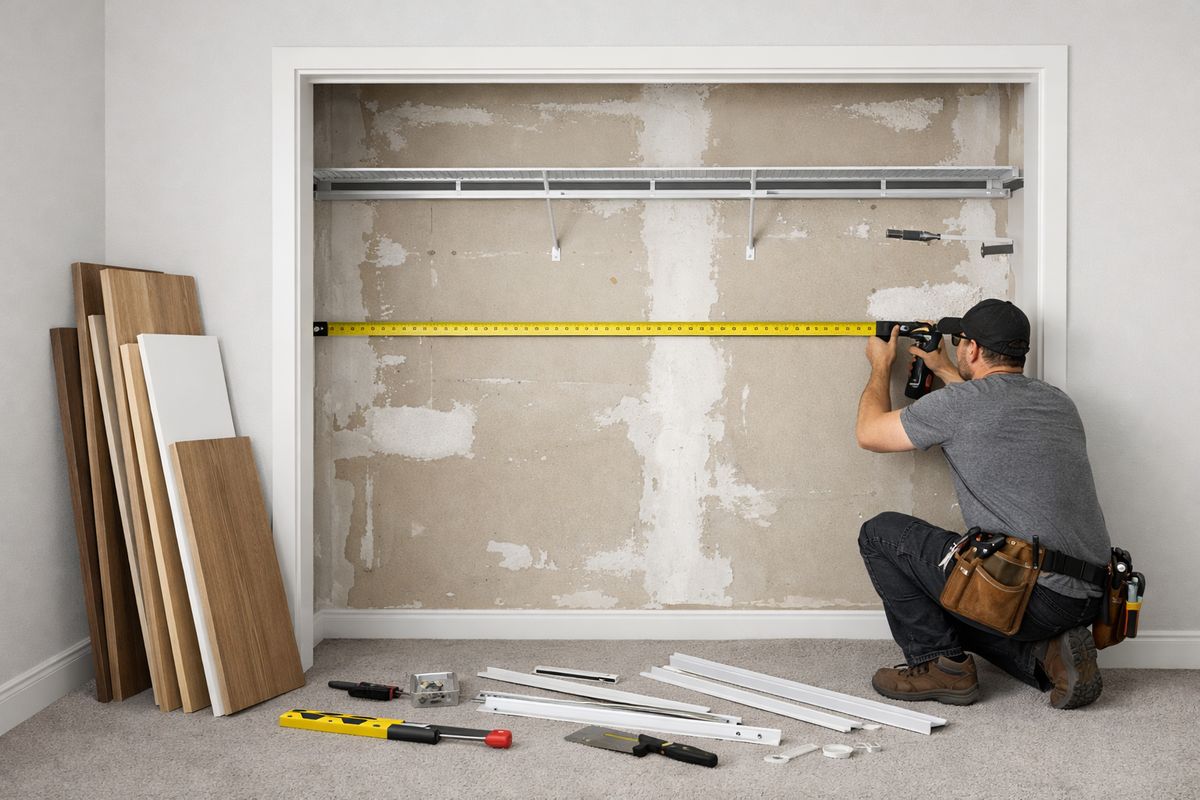
This is the part that gets skipped in casual price talk. Old wire shelving may need to come down. Drywall may need patching. Paint touch-ups may be needed. Debris has to go somewhere. Even basic prep and cleanup can add roughly $100 to $500.
That may not sound dramatic, but it matters because low quotes often leave this stuff vague. Then the surprises show up after the old system is removed and suddenly the wall behind it looks like Swiss cheese.
The biggest factors that change your final price
Two quotes for closets that look similar on the surface can come in wildly different. Usually, the difference comes down to closet type, customization level, and how many extras sneak into the design.
Closet size and type
Closet type gives you a useful starting range. Reach-ins often run about $500 to $3,000. Walk-ins typically land around $1,000 to $8,000. Built-in wardrobes often fall between $2,000 and $6,000, while free-standing wardrobes tend to cost about $1,000 to $3,000.
But size alone is not the whole story. A tiny reach-in with a weird soffit, narrow opening, and awkward depth can be more annoying to build than a straightforward larger closet. Layout drives effort. Effort drives price.
Level of customization
Prefab and modular systems cost less because they use standard sizes and simpler install methods. Some research puts prefabricated systems at about 60% less than fully custom builds.
That price gap is real, and sometimes worth taking. If your closet is fairly standard and your main goal is just to stop the overflow, modular can be a smart move. If you are still deciding between off-the-shelf pieces and built-ins, this breakdown of why basic organizers stop working for some spaces lays out the tradeoff clearly.
Features that push costs up fast
Drawers, shoe walls, tilt-out hampers, jewelry trays, glass-front cabinets, valet rods, and built-in LED lighting all sound manageable one by one. Together, they can change the quote in a hurry.
Extras often add $200 to $800 or more, especially when several are bundled. Lighting alone can land in that range. Shoe racks or cubbies may be modest individually, but a full shoe wall is not a small add-on anymore. This is where a project shifts from “fix the mess” to “build something beautiful,” and the cost follows.
Cost ranges by closet type and budget
A closet budget gets easier once you stop thinking in one giant number and start thinking in tiers. What matters is what you get at each level.
Budget-friendly: simple reach-ins and modular systems
This is the entry point for finally getting control of the mess without turning it into a major home project. DIY-friendly kits can come in under $1,000, and installed reach-ins often run about $500 to $3,000.
At this level, the win is function. Better hanging zones, a few shelves that actually fit folded clothes, and maybe simple shoe storage that gets things off the floor. It may not look like a dressing room in a magazine, but it can absolutely make your mornings easier.
Mid-range: semi-custom systems for everyday function
This is the sweet spot for a lot of homes. You get better materials, a layout that fits your actual wardrobe, cleaner finishes, and more flexibility for awkward corners or shared use.
If your goal is to make the space work for real life, not just look nicer, mid-range often gives the best return. It is also where options like a true built-in storage plan start making sense, because the design is tailored enough to solve the habits that cheap inserts never fixed.
Higher-end: walk-ins and boutique-style upgrades
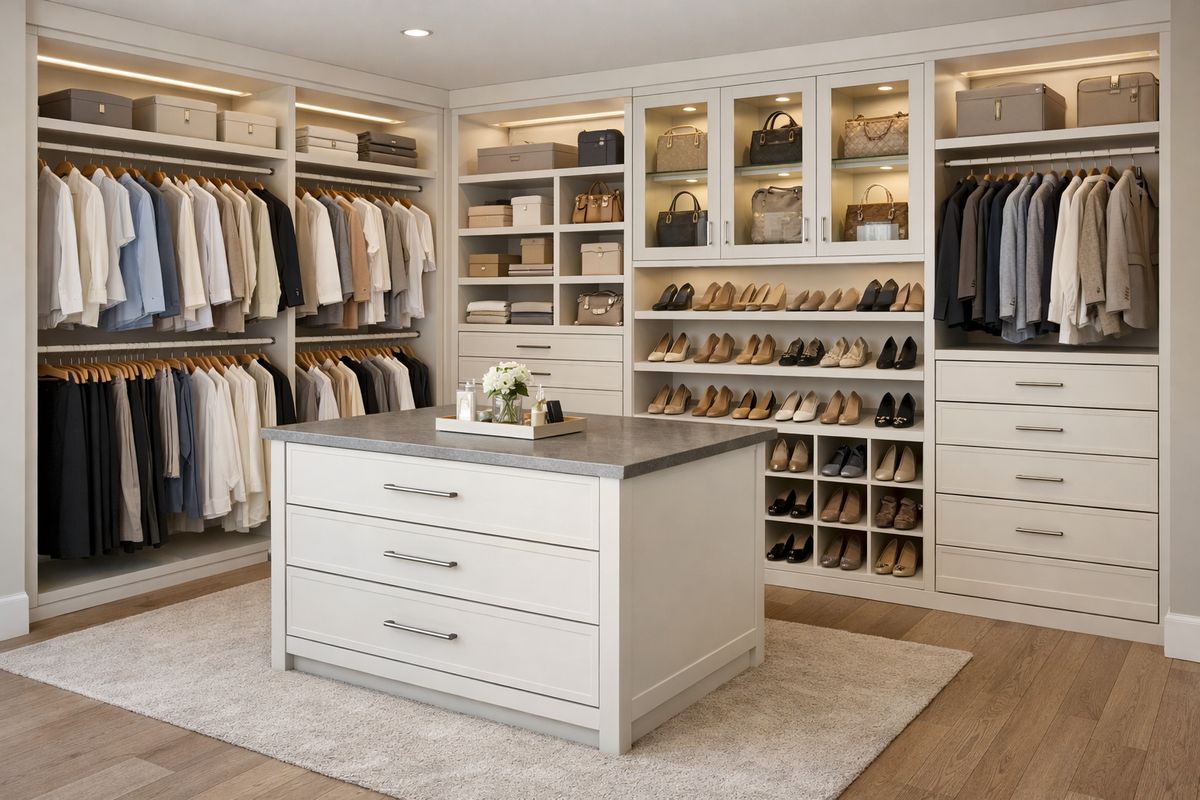
This is where full-height cabinetry, islands, integrated lighting, glass details, specialty accessories, and furniture-grade finishes come into play. Costs rise quickly here, and luxury walk-ins can exceed $50,000.
Sometimes that is overkill. Sometimes it fits the house, the budget, and the way you live. If your closet is part dressing area, part storage hub, part shared space, the premium tier can deliver a completely different experience. It just needs to be intentional, not just impressive.
How to compare quotes without getting tripped up
Closet quotes can look cleaner than they really are. One estimate may seem cheaper simply because it leaves things out.
What should be included in a quote
Look for design, site visit, measurements, materials, hardware, installation, demo, cleanup, touch-ups, and any follow-up adjustments after install. If any of that is missing, ask.
The cheapest quote is often just the thinnest quote. That is especially true if one bid includes removal of old shelving and wall patching while another quietly assumes you will handle it yourself.
Questions to ask before you sign
Ask about timeline, lead time for materials, who handles demolition, whether post-install adjustments are included, and what happens if the walls are uneven once the old system is out. Also ask whether tax, delivery, and hardware are included in the number on the page.
If you are comparing providers, it helps to know what separates a solid closet company from a flashy one before you focus on price alone. Good communication and clear scope save money later.
Red flags that can cost you more later
Be careful with vague allowances, missing labor details, unclear material specs, and quotes that skip prep work. A suspiciously low number can turn into change orders fast once demolition starts.
Another red flag is a layout that looks polished but does not reflect how you actually store things. If you share the space, planning for that up front matters more than upgraded drawer pulls. A setup built around how two people use one closet without fighting over it usually works better than one that just looks symmetrical.
How to decide what’s worth paying for in your closet
Good closet spending is not about adding every upgrade. It is about paying for the pieces that remove friction from your routine.
Features worth it for busy mornings
Double hanging sections are usually worth it. Drawers for smaller items are worth it. Eye-level shelves are worth it. Shoe storage that keeps the floor clear is worth it.
Those features save time because they reduce visual clutter and make your next step obvious. In a good closet, your hand knows where to go. That is the whole point.
Where you can save without regretting it
Standard finishes usually work just fine. Open shelving often works as well as extra cabinetry, and plenty of people actually prefer it. Fewer specialty accessories can also keep the budget grounded without hurting function.
The trick is to spend on structure, not sparkle. A clean layout with the right zones beats fancy details every time.
When custom is the smarter move
Custom earns its price when the room is awkward, the ceiling slopes, the reach-in is unusually tight, or the closet has to serve two sets of habits at once. It also makes more sense in a long-term home, where daily function compounds over time.
If no off-the-shelf solution has ever quite fit, that is usually the sign. Not because custom is fancy, but because the space is asking for a more exact answer.
Common closet installation mistakes to avoid
A closet project can cost real money and still disappoint. Most bad outcomes come from a few predictable mistakes.
Building for looks instead of habits
A showroom-style closet is useless if it ignores the way you actually live. If you wear mostly folded knits, stacks matter. If you own twenty pairs of flats and sneakers, floor-level shoe chaos matters. If bags, laundry, and belts float around the room, those need a home too.
Underestimating how much hanging and drawer space you need
This mistake shows up later, when the new closet looks neat for a week and then starts overflowing again. Good storage should fit your real volume, not the fantasy version where you suddenly become a minimalist.
Count what spills onto the dresser, the chair, or the floor now. That overflow is the truth.
Forgetting the room outside the closet
Closet design does not stop at the inside edge of the opening. Door swing, bedroom traffic flow, nearby furniture, and lighting all affect how useful the install feels.
A great closet should make the whole room work better. Not just the square footage behind the doors.
How to set a realistic budget before you make the call
You do not need a perfect number before getting estimates. You do need a framework.
A simple way to budget your project
Start with the base range for your closet type. Then add for better materials, labor complexity, and your must-have upgrades. Keep “must-have” honest. Drawers that stop daily mess count. A glass-front display cabinet for handbags probably does not.
Set two numbers before the first call: your target budget and your firm walk-away number. That keeps a good consultation from turning into an expensive fantasy.
One thing to try this week before getting estimates
Spend 15 minutes standing in front of your closet and make a quick list of what frustrates you most. Shoes on the floor. Folded stacks falling over. No place for laundry. Shelves too high to use. Clothes split between three rooms.
Then circle the three things that waste your time most often. Bring that list into every quote. It will make the conversation sharper, the design better, and the spending a lot easier to justify.
Frequently Asked Questions
Is closet installation cost usually charged by square foot or as a package?
Both show up. Some companies price around square footage, often in the $30 to $50 per square foot range, while others bundle design, materials, labor, and installation into one project quote. The package price is usually more useful because closets are rarely simple boxes.
Why is one closet quote so much higher than another?
Usually because the scope is different. Better materials, more drawers, more design time, tougher installation conditions, and included demo or cleanup can all raise the price. A lower quote is not always a better deal if it leaves out work you will end up paying for later.
Are custom closets worth it compared with organizers from a big-box store?
If your frustration comes from an awkward layout, shared space, or years of failed fixes, custom is often worth it. If your closet is a standard shape and just needs basic structure, modular organizers can do a solid job for less.
How much should you budget for a walk-in closet?
A typical walk-in often falls around $1,000 to $8,000, but premium versions can go much higher. Your budget depends on size, materials, number of built-ins, and whether you add features like lighting, islands, or glass-front storage.
Can you save money by skipping drawers and accessories?
Yes, often quite a bit. Drawers, hampers, jewelry inserts, and specialty racks add up fast. If your goal is function first, start with hanging space, shelves, and simple shoe storage, then add extras later if you still want them.
How many quotes should you get before choosing a closet installer?
Three is a good number. That gives you enough range to spot pricing patterns, compare scope, and notice when one company is vague. This week, make your frustration list first, then get quotes based on that same list so the comparisons stay fair.