


If your mornings start with a shirt half-hanging off a shelf, one shoe missing, and a chair doing the job your closet should be doing, you do not need more bins. You need better closet design ideas, the kind that fix how your space works at 7:15 a.m., not just how it looks in a photo.
Why closet design ideas work better than more storage gadgets
Most closet mess is not a character flaw, and it is not always a space problem either. Usually, it is a layout problem. If your closet makes you stack folded sweaters on a shelf too deep to see into, toss shoes in a floor pile, and balance handbags on the top shelf like a game of Jenga, the system is doing exactly what it was built to do. The mess is the result.
That is why real closet design ideas work better than another organizer insert from the big box store. Good design creates visibility, so you can see what you own. It creates access, so you can grab what you need without disturbing five other things. It creates zones, so your work clothes stop drifting into your weekend clothes and your gym gear stops living in a bedroom corner. It leaves enough flexibility to change when your wardrobe changes, and it makes maintenance easy enough that the closet does not fall apart by Thursday.
There is a reason so many homeowners are finally paying attention to storage. More than 65% of U.S. homeowners are investing in home improvement projects that include customized storage. That makes sense. Daily friction adds up fast.
1. Start with zones instead of one big catchall
A closet works better when it feels like a set of small, clear destinations instead of one large holding pen. Zoning is one of the highest-impact fixes because it removes decision-making. Your hand starts to know where to go before you even think about it.
Instead of treating the whole closet as clothing space, break it into practical categories: workwear, casual pieces, shoes, bags, accessories, laundry, and special-occasion items. That sounds simple, but it changes everything. When each category has a boundary, the closet stops behaving like a junk drawer in vertical form.
Give every category a home
When something has no fixed home, it wanders. That is how belts end up on a doorknob, jeans land on a chair, and the dry-cleaning pile starts living on the dresser. A good closet design solves that by assigning every category one permanent landing spot.
The trick is to keep those homes obvious. If your everyday handbag goes on one hook near the entrance, it is much more likely to return there. If your workout clothes live in the same drawer stack every day, you stop hunting for leggings in three different places. Simple beats clever here.
Build zones around your real routine
A showroom closet can be beautiful and still fail you. The reason is usually obvious once you think about your actual morning. You are not walking through your closet admiring symmetry. You are reaching for work pants, your go-to blouse, your bag, maybe a jacket, and trying to get out the door.
So build zones around life as it really happens. Weekday clothes should sit in the easiest, fastest spots. Weekend wear can go farther out. Event clothes do not need prime real estate if you wear them once every two months. The best layouts respect habit, not fantasy.
2. Add double hanging rods to multiply usable space
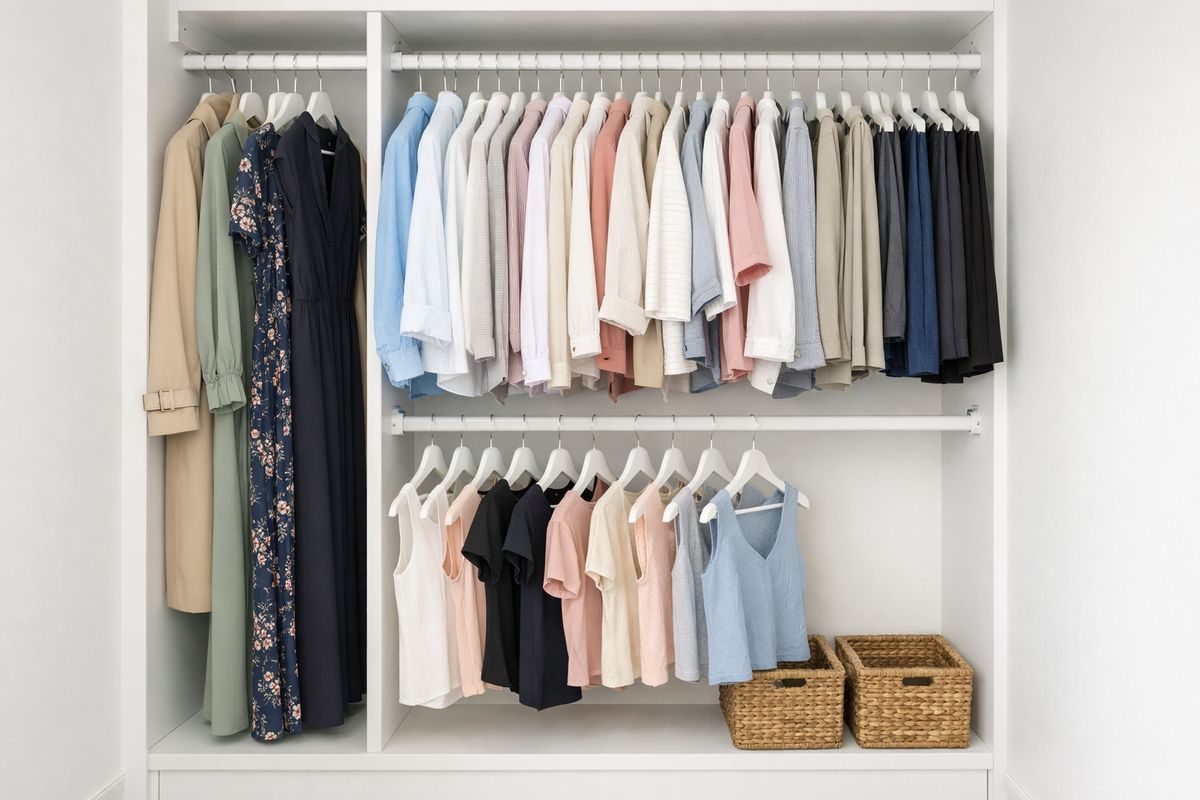
If your closet has one long rod with a lot of empty air underneath, you are leaving useful storage on the table. Double hanging rods are one of the smartest closet design ideas because they turn wasted vertical space into real capacity for shorter garments.
Button-down shirts, folded-over pants, skirts, and many tops do not need full-length hanging space. Adding a second rod below the first can nearly double that section’s function, as long as you have enough clearance to keep clothes from bunching. For many closets, this is the first change that makes the space feel like it finally makes sense.
Use upper and lower rods with intention
Do not just add two rods and start packing both tight. The upper rod works well for less-used categories or lighter items, while the lower rod is often easier for everyday grabs. Keep enough room so hangers can slide. If you have to yank clothes sideways to get one item out, the section is overloaded.
A useful rule is to reserve double-hang space for genuinely short-hang items. Research on tight reach-ins notes that a double-hang setup only works if rod spacing gives garments room to breathe. Otherwise, the upgrade backfires.
Leave room for long-hang pieces
Not everything belongs in a double-hang section. Dresses, coats, jumpsuits, robes, and anything that wrinkles easily need taller clearance. If your closet design ignores long-hang storage, those pieces end up folded badly, crammed sideways, or relocated to another room.
Even a small closet should keep one clean vertical stretch for longer items. It does not need to be huge. It just needs to exist.
3. Replace deep mystery shelves with drawers that pull out
Fixed shelves seem practical until you live with them. Then socks slide to the back, T-shirts become unstable towers, and small things disappear into dark corners like socks in a dryer. Drawers solve that because they bring the contents to you.
That is the real difference. A shelf asks you to reach in and excavate. A drawer pulls the whole category forward. For undergarments, sleepwear, folded tees, workout clothes, and accessories, drawers are easier to use and much easier to keep contained.
Use shallow drawers for small items
Shallow drawers are especially useful for the little categories that cause disproportionate irritation. Jewelry, sunglasses, ties, belts, watches, and scarves do not need deep storage. Deep storage just gives them room to tangle.
A shallow drawer forces a better setup. Items stay visible, categories stay tighter, and the morning search goes from annoying to automatic.
Choose dividers that keep categories from collapsing
The best drawer can still turn into a mess if every category slides into the next. That is where simple dividers earn their keep. Nothing fancy, just enough separation to keep socks with socks and tanks with tanks.
Here’s the thing: good dividers are not there to make the drawer look pretty on day one. They are there to help the drawer survive a messy Tuesday night. If you are comparing systems, this is a good moment to read about what tends to work better than add-on organizers, because layout always matters more than accessories.
4. Make shoes visible instead of stacked in a heap
Shoe clutter spreads fast. One pair by the door becomes three. Three becomes a floor pile. Suddenly the whole closet feels messy, even if the hanging clothes are perfectly fine.
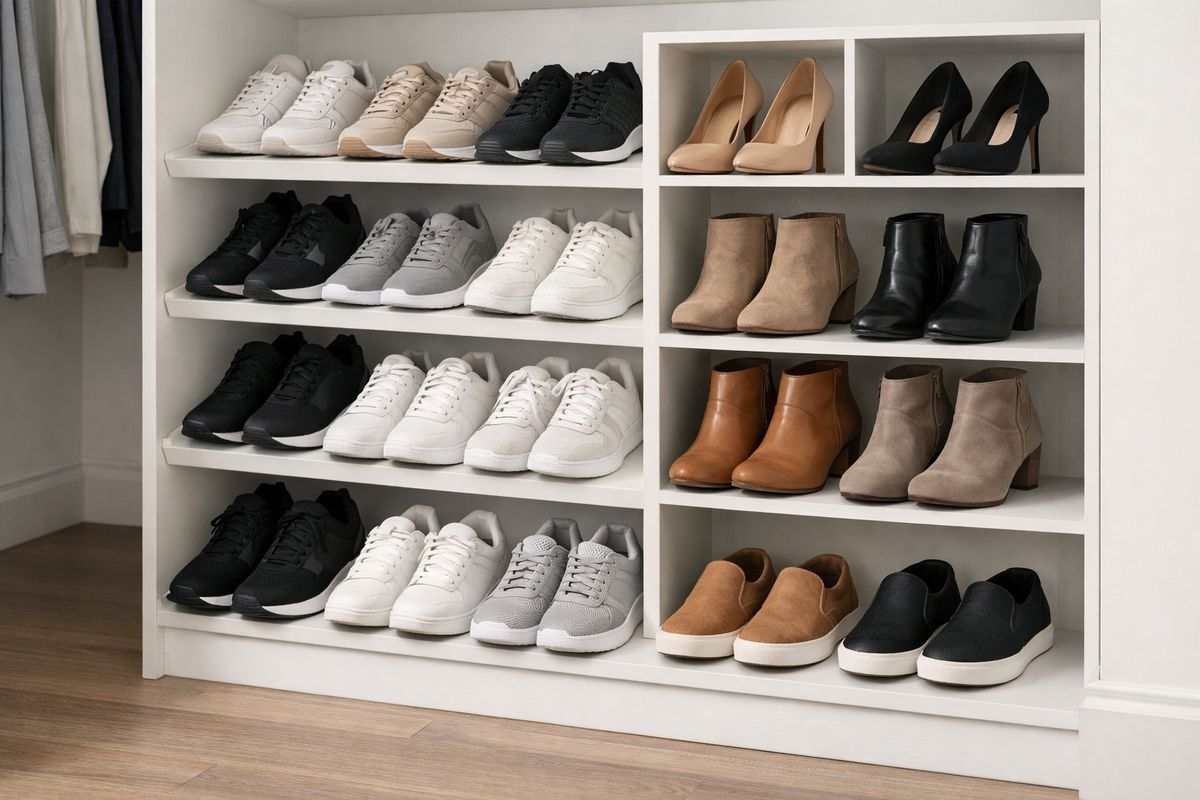
A dedicated shoe zone fixes more than footwear. It clears floor space, reduces visual noise, and stops the daily crouch-and-dig routine. Angled shelves, cubbies, flat ledges, and pull-out racks all work, as long as you can actually see the pairs.
Match the shoe storage to the shoe type
Sneakers do not store like heels, and boots do not behave like sandals. Everyday pairs need fast access and enough room that you are not scraping one shoe against another. Heels often work well on slightly angled shelves. Boots may need taller cubbies or supports so shafts do not collapse.
This is where generic shoe racks often fail. They treat every pair the same, and your closet does not.
Keep daily pairs at eye or floor level
The shoes you wear four times a week should not live on the top shelf. Put daily pairs low enough to grab without effort, ideally near the closet entrance or at the most natural stopping point in your routine.
Research on access zones recommends keeping current-season clothing and commonly used items within the eye-level range. That same idea works for shoes. Prime space should go to prime use.
5. Use adjustable shelving so the closet can change with you
Your closet should be able to evolve. A fixed layout can look neat on install day and become frustrating a year later when your wardrobe shifts, your needs change, or one category suddenly expands.
Adjustable shelving solves that because it gives you options without requiring a full redesign. More sweaters in winter, fewer handbags, bulkier denim, new hobbies, kids leaving home, workwear shrinking, travel gear growing, life changes. Your closet should not lock you into one version of yourself.
Avoid locking the whole design into one season of life
Closets fail when every inch is designed for today and nothing is adaptable for tomorrow. The problem gets worse in homes where storage has to work hard over time.
That is one reason tailored layouts keep gaining traction. Demand keeps growing for storage that fits real habits and dimensions, not generic assumptions. If you are weighing whether a more built-in solution makes sense, signs that your space has outgrown quick fixes can help clarify it.
Rework shelf height by category
Different items need different breathing room. Folded jeans can handle a moderate shelf opening. Sweaters need enough vertical space that stacks do not compress into a lumpy wall. Handbags often need taller cubbies. Bins need exact spacing or they become awkward to pull out.
Adjustability means you can tune shelf height to the category instead of forcing every category into the same box.
6. Build in a real home for bags, hats, and accessories
Accessories cause a surprising amount of clutter because they are easy to set down and easy to forget. A single shelf can turn into a tangle of handbags, scarves, hats, and small leather goods in about two days.
A better closet gives these supporting players their own infrastructure: hooks for bags, trays for jewelry, small cubbies for hats, and a place for the pieces you use often enough to need quick access. Once those items stop roaming, the entire closet looks calmer.
Keep grab-and-go items near the entrance
Placement matters as much as storage type. The bag you carry to work, the cap you wear for weekend errands, and the belt you grab before walking out should sit near the closet entrance or on the easiest side of your routine flow.
That is what makes a space feel intuitive. You do not want to cross the whole closet and dig through a top shelf for something you use every day.
Use trays or divided inserts for small accessories
Jewelry and sunglasses need containment more than depth. Trays, shallow inserts, and divided compartments keep these categories from tangling into one frustrating pile.
This is also where personalization matters. If your routine includes watches, scarves, or a rotation of handbags, your storage should reflect that. A layout shaped around your actual habits will always outperform a standard template.
7. Add lighting that lets you actually see what you own
Bad closet lighting wastes time and money. It hides navy next to black, buries the sweater you forgot you owned, and makes upper shelves feel unusable. It also makes the whole closet feel smaller than it is.
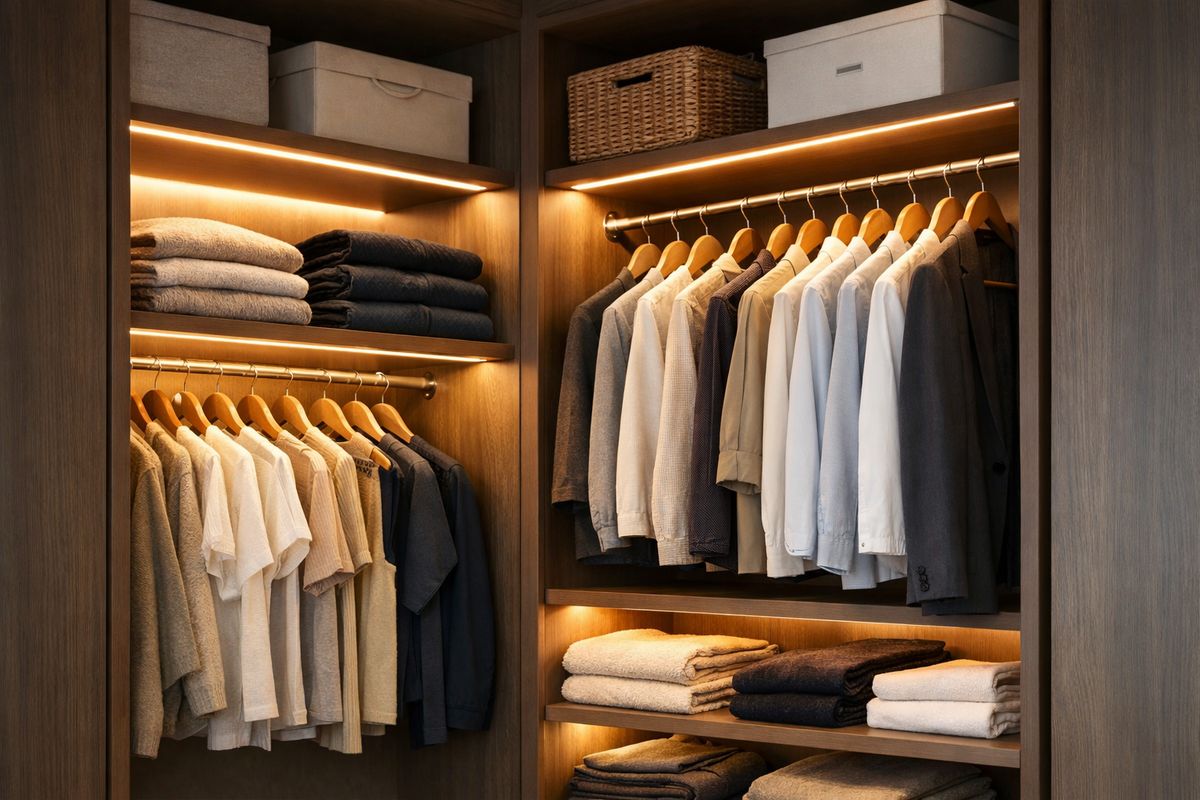
Lighting is one of the fastest upgrades with the biggest everyday payoff. LED strips under shelves, puck lights in dark sections, or improved overhead fixtures can transform how the closet functions without changing the footprint at all.
Light the dark corners and upper shelves
Corners, top shelves, and deep side walls are where clutter likes to hide. If those areas stay dim, they become storage for things you stop using because you stop seeing them.
Targeted lighting fixes that. Research-backed guidance suggests closet LEDs around 3000K lighting for a warm-but-clear view, with enough fixture coverage to eliminate shadow pockets.
Choose lighting that helps with color and detail
You want light that shows fabric color accurately, not light that makes every shirt look vaguely beige. Warm light can feel cozy, but too warm can distort color. Very cool light can feel harsh. A middle range usually works best because it helps you tell black from navy and cream from white without making the closet feel clinical.
In practice, good lighting makes you trust your closet more. That matters.
8. Include a full-length mirror where you use it, not where it fits
A mirror should support your routine, not fill leftover wall space. If the only full-length mirror is across the bedroom, clothes tend to migrate there for a final check, and sometimes they stay there in a pile.
Putting the mirror inside the closet or just outside it keeps the whole dressing process in one zone. That saves steps and cuts down on the half-dressed shuffle between rooms.
Place the mirror near good light
A mirror near decent light helps you make faster, better decisions. You can judge color, fit, and proportion without second-guessing everything. That alone can shave minutes off a rushed morning.
Try to place it where you naturally pause when getting dressed. The exact spot matters less than the fact that it supports movement instead of interrupting it.
Use mirrored doors if space is tight
If floor or wall space is limited, mirrored closet doors can do double duty. You get a full-length view without adding another object to the room, which is especially helpful in smaller bedrooms or narrow reach-in setups.
It is a simple move, but a smart one.
9. Create a drop zone for laundry, donations, and repairs
The best closets do not just store clothes. They also help things leave. That is the catch most closet plans miss. If there is no clear exit for dirty items, damaged pieces, or clothes you no longer want, those categories drift into corners and become permanent clutter.
Build in a hamper, a donation bin, and a small repair basket. Suddenly the closet can handle reality instead of pretending every item belongs there forever.
Add an exit-only donation spot
A donation area should have one job: out. Not maybe later. Not seasonal holding. Out.
This one idea is more powerful than it sounds because it gives unwanted items momentum. The minute a shirt no longer fits, feels wrong, or has not been worn in ages, it goes to the exit zone instead of sliding back onto a shelf. That single change often matters more than buying another organizer.
Separate dirty, damaged, and wearable clothes
One basket for everything creates work for your future self. Dirty laundry, loose-button shirts, dry cleaning, and still-clean pieces should not mingle in one soft-sided mountain.
Separate streams make the system faster. A hamper for laundry, a bin for repairs, and the closet itself for wearable clothes. Done.
10. Carve out a small staging space for next-day outfits
This is one of the most practical closet design ideas in the whole list because it addresses the exact moment your closet tends to fail: tomorrow morning. A small staging area turns the closet into a planning tool instead of a storage unit.
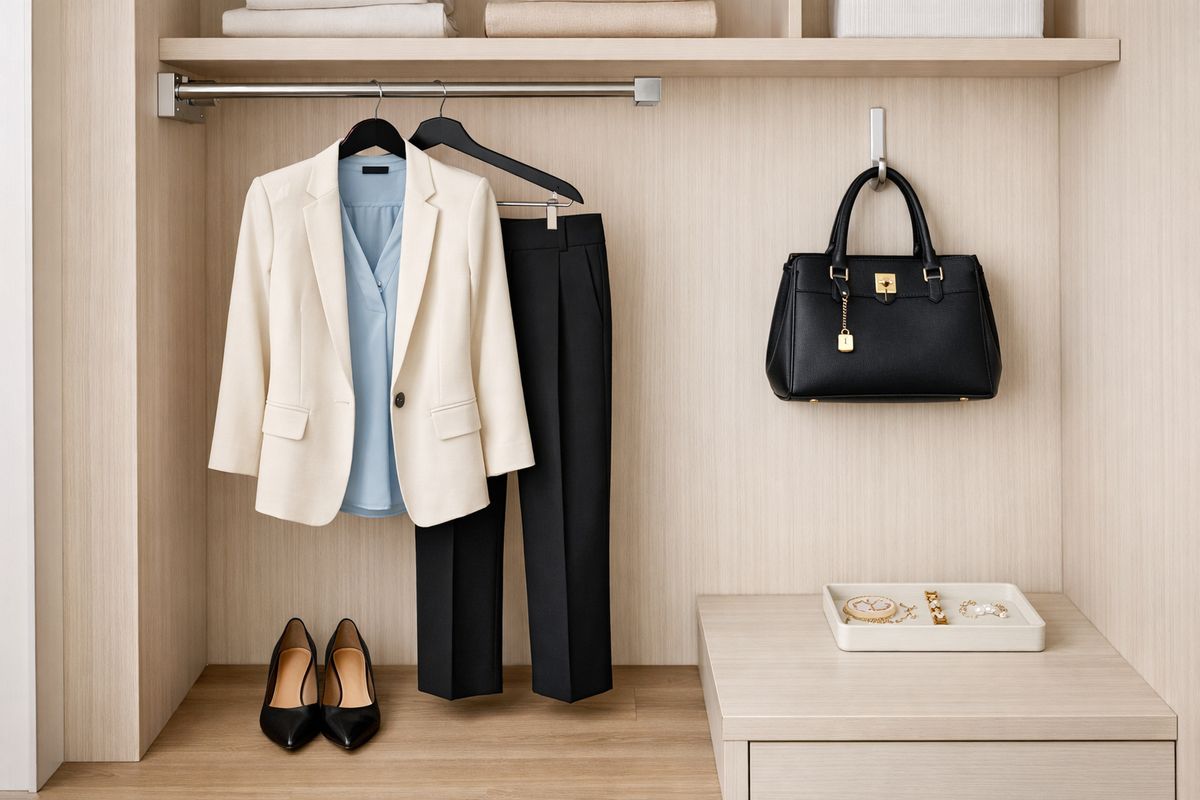
You do not need much. A valet rod, one hook, or a narrow shelf can hold tomorrow’s outfit and remove half the decision-making before the day even starts.
Use a valet rod for outfit planning
A valet rod is simply a short pull-out or fixed rod meant for temporary hanging. It gives you a place to set aside one outfit without sacrificing your main hanging space.
That is useful for workwear, travel prep, early meetings, or events when you want everything ready the night before. It sounds small. It feels huge at 6:45 a.m.
Store the extras together
An outfit is not ready if the shirt is hanging there but the shoes are missing and the bag is still somewhere in the bedroom. Keep the extras together: shoes below, bag nearby, jewelry in a tray, jacket on the same hook or rod if possible.
Once that setup becomes part of your routine, mornings feel less like a scavenger hunt.
11. Use vertical space all the way to the ceiling
Most closets waste the highest zone. There is often a shelf near the top, but it becomes a dumping ground because it was never planned with real categories in mind. That is a shame, because high storage can be extremely useful.
The key is to reserve that upper zone for low-frequency items: luggage, keepsakes, off-season clothing, travel bags, and backup bedding if your closet has the room. High storage should support the closet, not sabotage it.
Reserve high shelves for low-frequency items
Anything you use weekly should stay within easy reach. Anything you touch a few times a year can move up high. That simple distinction makes upper shelving far more functional.
Older homes especially benefit from this kind of deliberate planning because storage can be awkward and limited. If you are working around tight dimensions or odd layouts, understanding what a more tailored setup can include helps you spot opportunities generic kits miss.
Use labeled bins so upper storage stays usable
Upper shelves become black holes when everything is loose and unlabeled. Matching bins and clear labels keep that area from turning into attic overflow.
Even if you know what is “probably up there,” labels save time and reduce the urge to shove one more random thing onto the top shelf.
12. Give folded clothes proper shelf depth and spacing
Shelf dimensions matter more than most people think. Too shallow, and stacks tip forward. Too deep, and clothes disappear in the back. Too close together, and every pile looks compressed and chaotic.
For many reach-in closets, shelves around 14 to 16 inches deep hit the sweet spot. That is enough room for folded jeans and sweaters without creating dead space you cannot easily use.
Prevent the “stack avalanche” problem
You know the move: pull one sweater from the middle and the whole pile slides sideways like a collapsing sandwich. That usually happens when shelves are too deep, stacks are too high, or spacing between shelves is too tight.
Good shelf design prevents that by giving folded clothes enough support and enough visibility. You should be able to remove one item without triggering a landslide.
Limit how high each folded stack gets
Keep folded stacks shorter than you think. A practical limit is usually five to seven items per stack, depending on thickness. Beyond that, the pile gets unstable and the bottom items become invisible anyway.
This is one of those small rules that keeps a closet usable day after day.
13. Add closed storage for the items you don’t want to see every day
Open storage is great for visibility, but too much of it can make a closet feel noisy. Not everything needs to be on display. Backups, shapewear, sentimental pieces, travel gear, old photos, gift wrap, random odds and ends, some categories simply look better hidden.
Closed drawers or cabinets give the eye a place to rest. That makes the whole closet feel calmer, cleaner, and more intentional.
Hide the messy categories on purpose
There is no prize for making backup toiletries or a pile of spare hangers look beautiful on open shelving. Hide the visually messy stuff and let the useful, attractive categories stay visible.
This is not cheating. It is good design.
Mix open and closed storage for balance
The sweet spot is usually a mix. Keep everyday clothes, frequently used bags, and current shoes visible enough to access easily. Hide the categories that add clutter without adding convenience.
That balance gives you both function and calm, which is really the goal.
14. Connect the closet to nearby routines when possible
A closet works best when it sits inside a useful flow. Think about the path from getting undressed, to dropping laundry, to showering, to getting dressed again. Every extra step increases the chance that clothing ends up on a bench, floor, or chair instead.
This does not have to mean a luxury suite. It just means paying attention to motion. If the closet can sit near the bathroom, dressing area, or laundry path, life gets easier.
Shorten the path between dressing and laundry
The farther the hamper is from where clothes come off, the more “temporary” piles you get. A nearby laundry drop or built-in hamper shortens that path and quietly changes behavior.
The same logic applies to ironing supplies, dry cleaning, and even shoe storage. Things return more reliably when they do not require a detour.
Think in terms of motion, not just square footage
A larger closet is not automatically a better one. If the layout makes you backtrack, reach awkwardly, or move between three rooms to finish getting dressed, the space is underperforming.
Picture a real weekday morning. You wake up, get dressed, grab your bag, and leave. The best closet design supports that motion like a well-set kitchen supports dinner prep. That is why professionally planned custom closet layouts can feel so different from a collection of add-ons. The flow is built in.
15. Design for maintenance so the mess doesn’t come back
A closet that only works right after a reset does not really work. The best closet design ideas reduce friction enough that tidying becomes almost automatic. That means simple categories, enough space to put items back easily, and a layout that tolerates normal life.
Research on home organization keeps coming back to the same point: disorganization causes most clutter, not simple lack of space. In fact, 80% of household clutter is attributed to disorganization. Your closet needs a system you can keep, not just admire.
Keep a little empty space on purpose
An overfilled closet is always one busy week away from collapse. Leave breathing room in drawers, shelves, and hanging sections. Some organizing guidance suggests leaving about 20% of storage space empty, and honestly, that feels right in real life too.
Empty space is not wasted space. It is what keeps the system alive.
Set up one weekly five-minute reset
You do not need a Sunday overhaul. You need five minutes. Put stray shoes back, return the handbag, move repairs to the repair bin, and clear the donation spot if it is getting full.
That tiny reset supports the design instead of replacing it. It is the difference between a closet that stays functional and one that slowly drifts back to chaos.
How to choose the right closet design ideas for your space
Not every idea belongs in every closet. The right solution depends on the type of closet you have and the friction points causing the mess. If your issue is shoes on the floor, solve that first. If the real problem is folded piles collapsing or terrible lighting, start there instead.
The goal is not to copy a dream closet online. It is to fix the bottleneck in your own daily routine.
For small reach-in closets
Small reach-ins usually benefit most from double rods, shallower shelves, vertical storage, and a mirror on the door or nearby wall. Deep shelves are especially unhelpful here because they hide clothes and waste access. Keep current-season items in the most reachable band, use the top shelf for low-frequency storage, and avoid bulky bins that eat the limited depth.
A reach-in needs discipline from the design itself. Every inch should earn its keep.
For walk-in closets
Walk-ins have more room, but that does not mean they are easier to organize. In fact, bigger closets can become giant catchalls if the zones are not clear. Prioritize defined sections, better lighting, accessory storage, and enough open floor or center clearance to move comfortably.
If space allows, a central surface or narrow island can be useful for folding, staging outfits, or storing accessories. But only if it does not interrupt flow.
For older or awkward closets
Older homes often come with odd corners, narrow depths, sloped ceilings, and a level of charm that does absolutely nothing for storage. These spaces need realistic planning more than generic solutions. A 1920s closet might never hold every pair of family shoes, and pretending otherwise just creates frustration.
In awkward spaces, custom planning matters because standard kits rarely account for the weird angles and tight dimensions that define older homes.
Common closet design mistakes that keep the mess alive
A closet can look upgraded and still function badly. That usually happens when the design choices are based on photos, trends, or products instead of habits and dimensions.
The good news is that the common mistakes are predictable, which means you can avoid them.
Designing for looks before habits
A beautiful closet fails when it ignores what you actually wear, what you reach for daily, and how you move through the space. Open shelves full of perfectly spaced handbags look lovely until your life includes laundry piles, rushed mornings, and real shoes.
Function should drive the design. Looks should follow.
Buying inserts before fixing the layout
This is probably the biggest mistake of all. Buying organizers before solving the layout is like buying prettier containers for a junk drawer and expecting the drawer to become useful.
Measure first. Identify the friction point first. Then decide whether you need different shelves, rods, drawers, lighting, or a more thorough redesign. If budget is part of the picture, it helps to understand what you are actually paying for in a closet project before you start collecting accessories that may not solve the problem.
Try one fix this week before you redesign the whole closet
You do not need to redo everything at once. Pick the one friction point that annoys you most. The shoe pile. The missing donation spot. The folded shelf that collapses every time you touch it. The dark corner where good clothes go to disappear.
Fix that one thing this week. Add a real laundry drop. Clear a zone for daily shoes. Move tomorrow’s outfit onto a hook tonight. Once one part starts working, the rest of the closet gets easier to see clearly.
Frequently Asked Questions
What are the best closet design ideas for a small closet?
The best small-closet ideas usually focus on double hanging rods, shallower shelves, vertical storage, and better lighting. Small closets do better with tighter categories and fewer deep bins. The goal is to make every item visible and reachable.
Are custom closet systems worth the money?
If your current closet creates daily frustration and generic organizers have already failed, a custom system can be worth it because it solves the layout, not just the symptoms. Cost matters, of course, but a system built around your wardrobe and space usually lasts longer and works better than piecemeal fixes.
How deep should closet shelves be?
For many reach-in closets, 14 to 16 inches is a strong range. That depth supports folded clothes without pushing items too far back. Shelves that are much deeper often hide clothing and make stacks harder to manage.
Is it better to hang or fold clothes in a closet?
Hang structured pieces like dresses, blouses, jackets, and trousers that wrinkle easily. Fold sweaters, knits, tees, and other items that can stretch on hangers. The best closet designs match storage type to garment type instead of forcing everything onto rods or shelves.
How do you keep a newly organized closet from getting messy again?
Design for maintenance. Leave some empty space, keep categories simple, add an exit-only donation bin, and do one five-minute reset each week. If putting something away feels easy, you are much more likely to do it.
What should you do before redesigning a closet?
Start by identifying what is actually failing. Maybe shoes are taking over the floor. Maybe folded shelves are too deep. Maybe there is no place for laundry or accessories. Once you know the real pain point, the right design ideas become much easier to choose.